RBK · Rhys Briffa · WollongongFeels Like Extortion
STREET IMAGE ONLINE. POLICE ON SPEED DIAL.
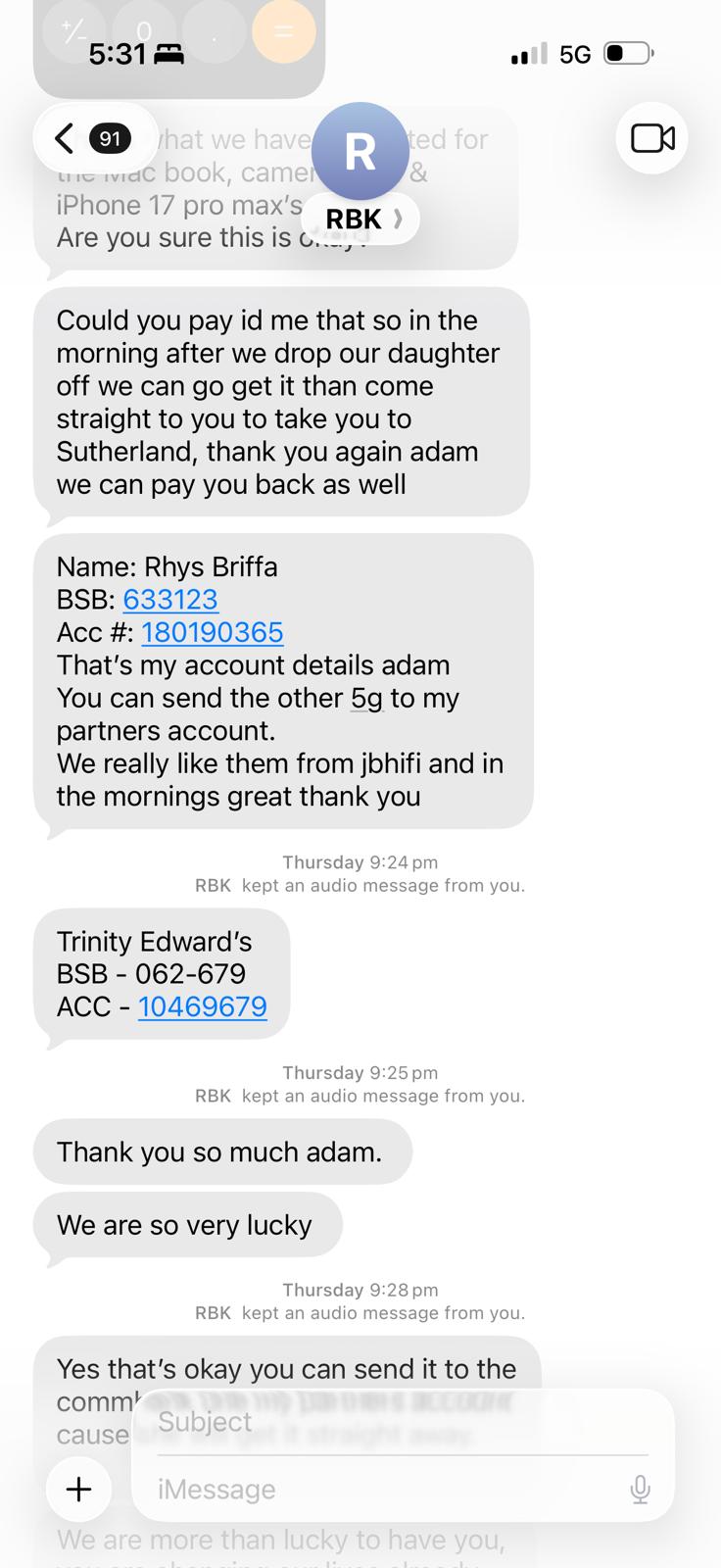
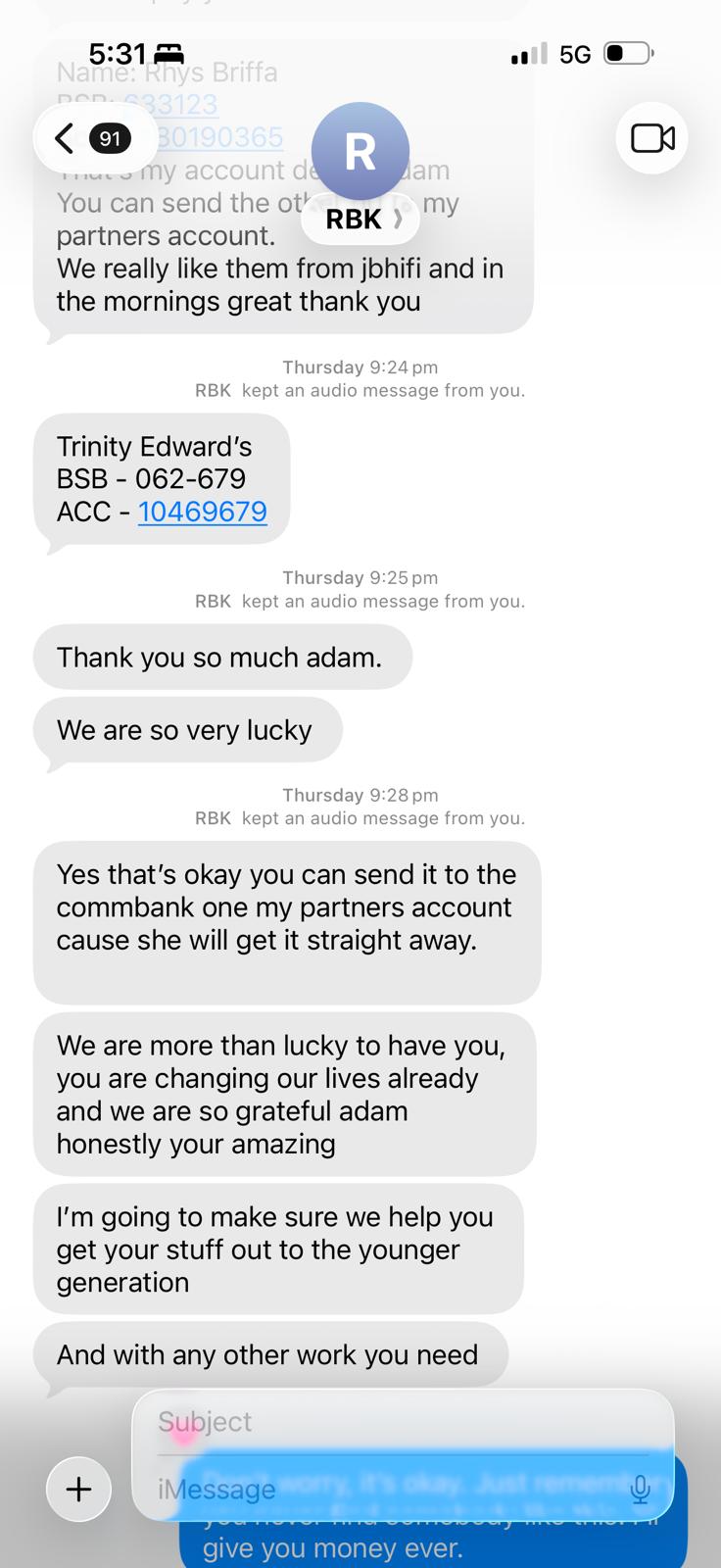
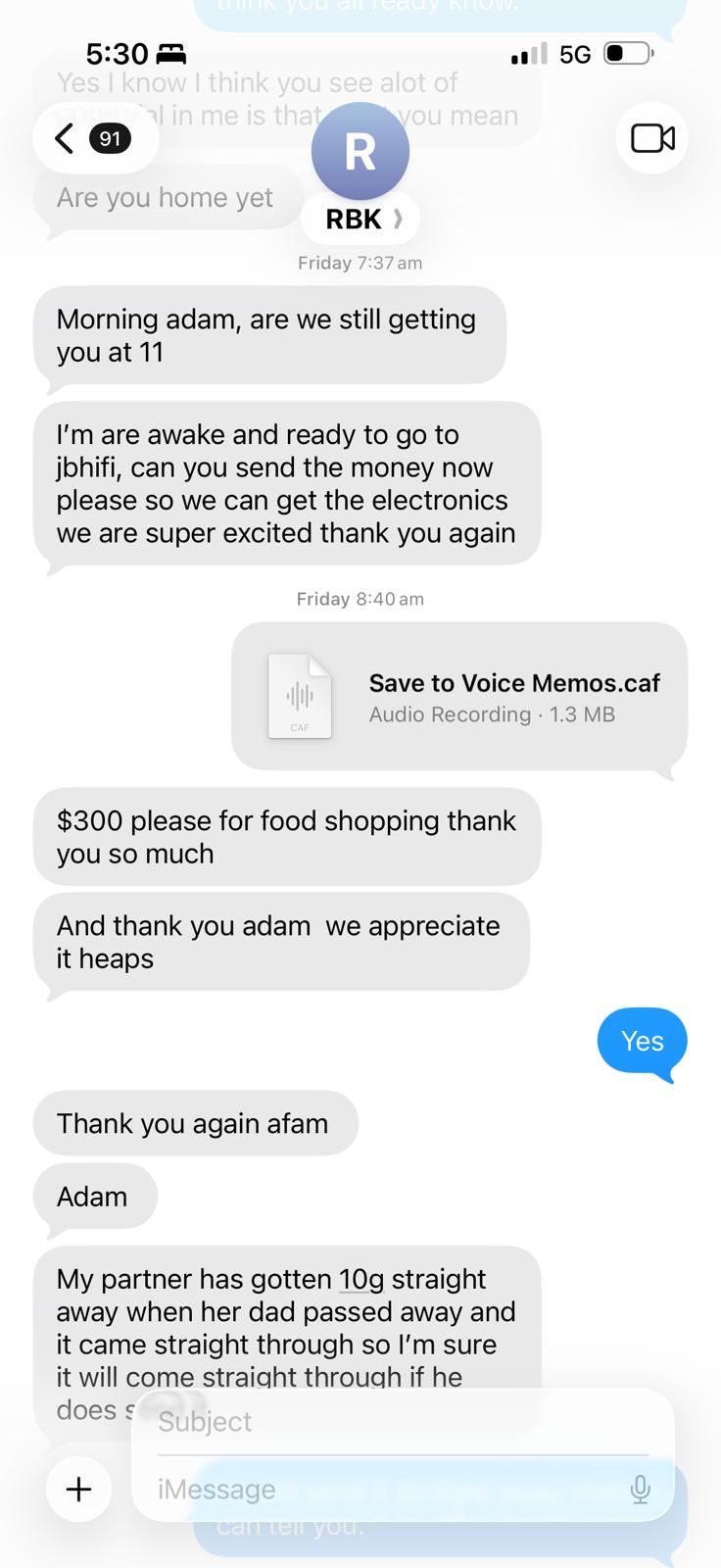
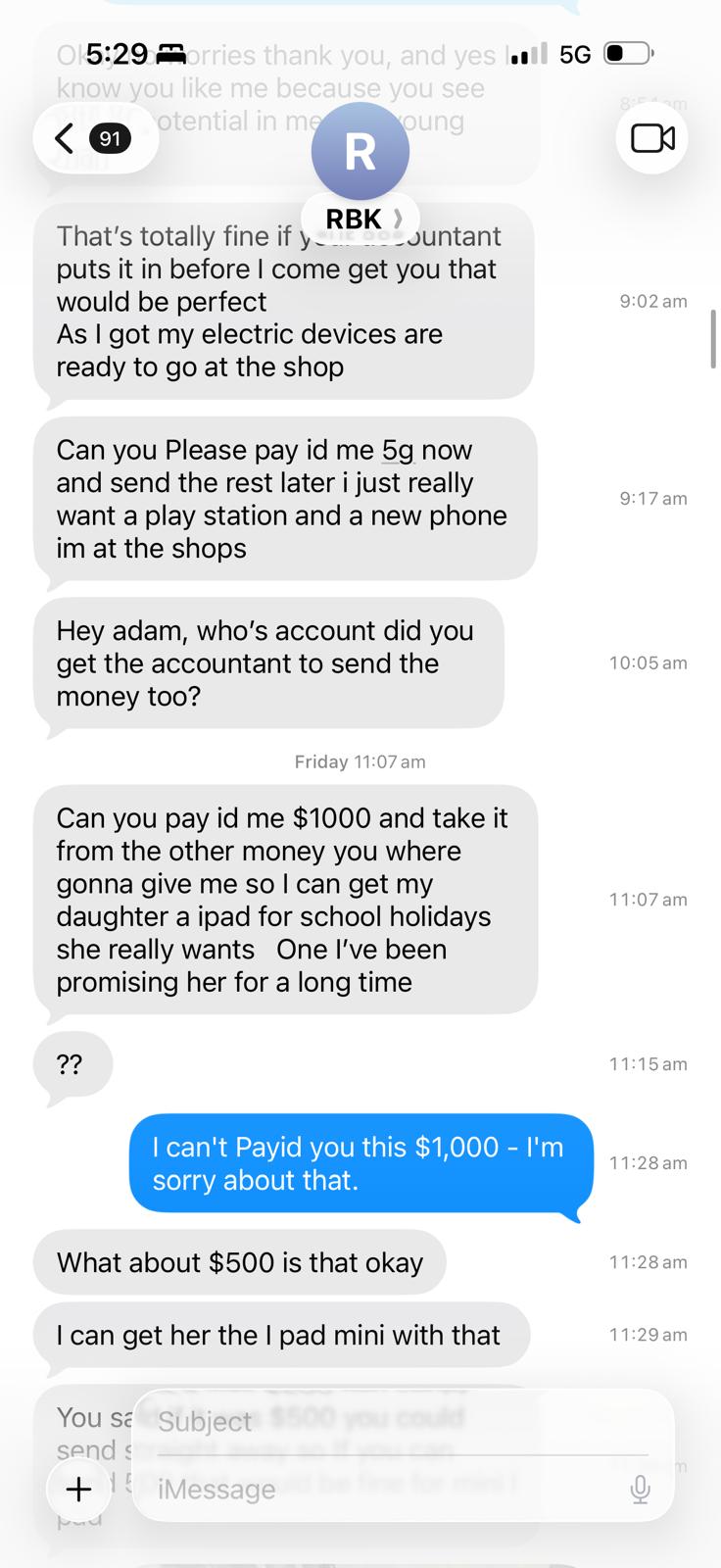
Adam engaged a rapper for some videos. What came back were strange messages, a girlfriend demanding money, and threats to call the police — all while still asking for feedback on the video. The whole thing has started to feel like extortion.
The NSW Land and Housing Corporation consented to a tribunal order — mould remediation, repairs, rent capped at $77.95 — by 1 November 2025. The deadline passed. The repairs weren't done. Then the power failed at a life-support address. Then the rent went to $520. This is what happens when an order has no enforcer.
New Character — RBKRhys Briffa · Wollongong · Romance Scam · Extortion
RBK. STREET IMAGE ONLINE. POLICE ON SPEED DIAL.
"Adam engaged a rapper for some videos. What came back were strange text messages, a girlfriend demanding money outside a business associate's building, and threats to call the police — all while still asking for feedback on the video. The whole thing has started to feel like extortion."
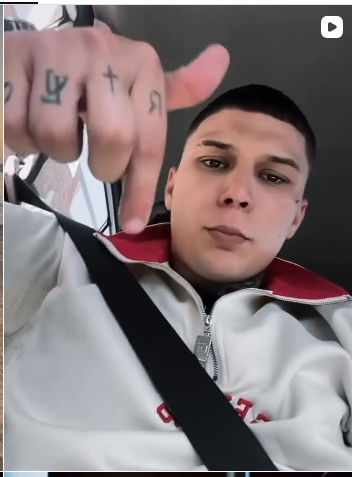
RBK · real name Rhys BriffaRapper · Wollongong, NSW
How It Started
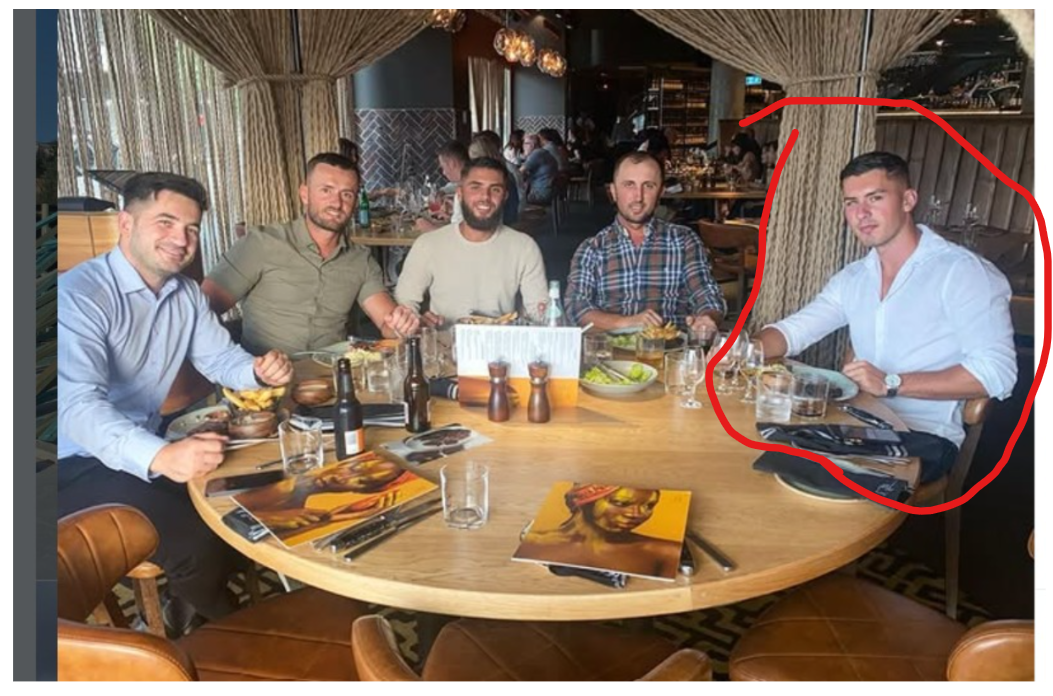
The rapper goes by RBK; his real name is Rhys Briffa. Adam Watson found him on TikTok, watched his videos, and wanted some made for his political campaign. In the course of chatting, Adam was — as he tends to be — honest: he shared that he likes bad boys, and that he is bi-curious.
Rhys reciprocated the candour. He confided that he has always known he is bisexual, and told Adam he would leave his girlfriend for him — or, in his words, that she "doesn't have to know." Adam declined. He said he could not do that. Rhys has a child and lives in Wollongong.
What This Is — A Romance Scam
Read as a whole, the pattern has the hallmarks of a romance scam: feigned attraction and talk of leaving a partner, used to manufacture closeness — followed by money changing hands, then denial, threats, and the police. The romance is the lure; the money is the point. That is the thread running through everything below.
The Girlfriend · The $1,000⬤ LOOKS LIKE EXTORTION
SHE TURNED UP AT ADAM'S OWN BUILDING. HE TRIED TO HELP — AND GOT SPAT IN THE FACE.
Adam had a meeting with Rhys. The next day, Rhys's girlfriend came looking for Adam — at Adam's own building, a $415 million project of which Adam Watson is the sole director and sole shareholder. She began making accusations that Adam was trying to steal Rhys from her. Robert Huang gave her $1,000 to go away. From that point, the whole thing began to look like extortion.
It escalated. Rhys's girlfriend called Robert Huang an "asian cunt." To be clear, Adam did not lose any contracts over this — but that is not the point. A partner turning up unannounced at the people you do business with, hurling racial abuse, is creating unnecessary drama that has no place anywhere near a serious commercial project.
And this is the part that stings: Adam tried to help this guy — paid work, a platform, genuine belief in him — and all he got in return was spat in the face.
The Messages — In His Own Words
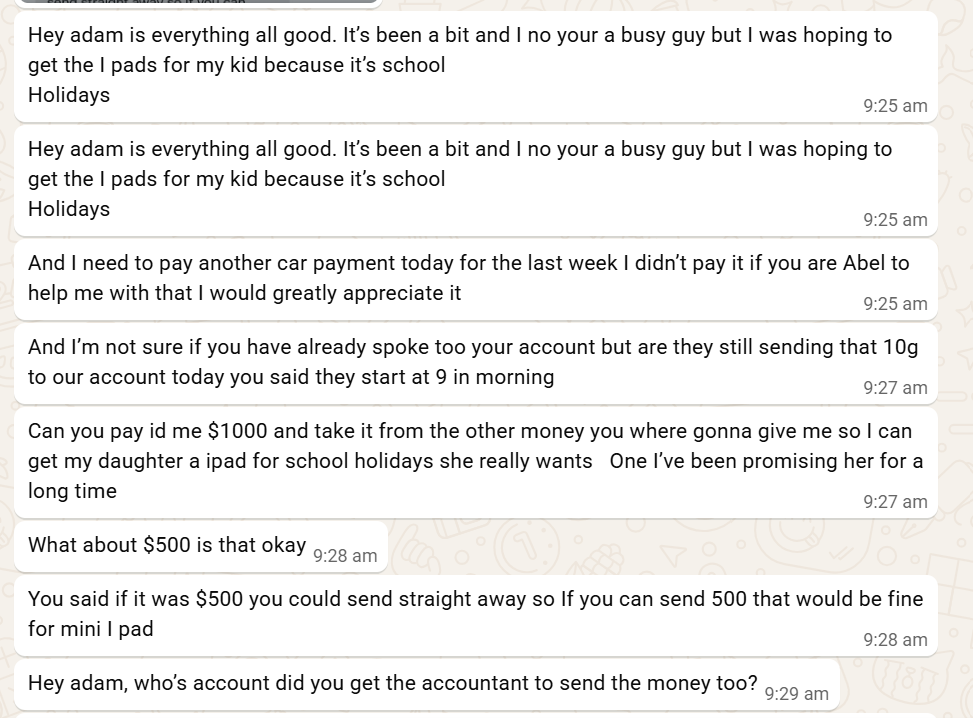
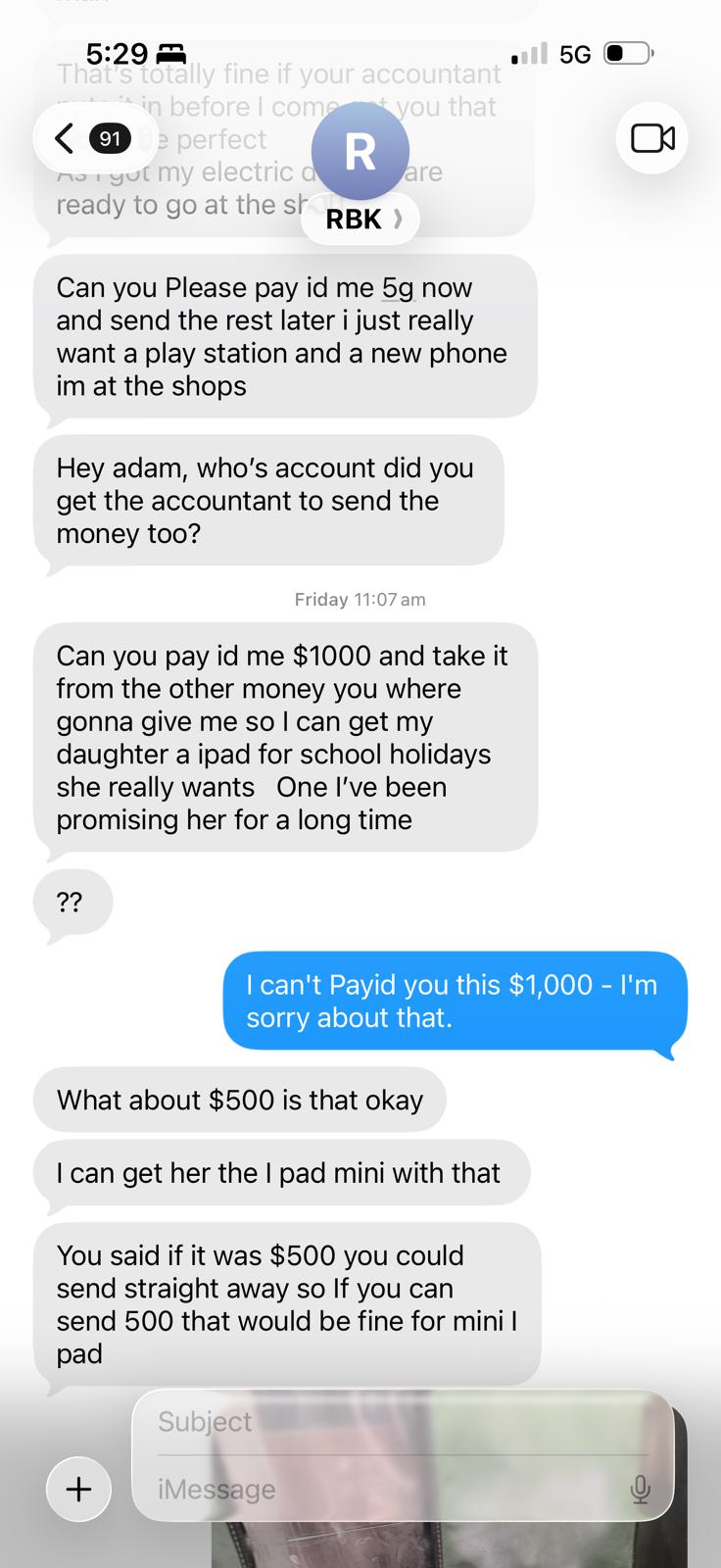
Rhys's messages to Adam are a study in contradiction. In one, he casts Adam as the aggressor, denies wanting the money he had already taken, and — remarkably — boasts that his lawyer just got him off a 10-year sentence:
"Your just a creep cuz so do what you want I tried to say I'll do the video now you don't want to you kept offering me money's saying you like me asking me if I was bye sexual and shit so you definitely wanted more then a video now I don't want to be a part of this creepy shit you wanna get upset once again you never said I have to pay you back
You clearly stated you will give me what ever I want all I have to do is ask and you sent money to me when I asked you can take what you want to court but my lawayer is very good he just got me off a 10 year sentence so I will see in court Adam"
— Rhys Briffa (RBK), to Adam Watson
Adam's Answer — "See You in Court"
Rhys wants to talk about lawyers and court. Adam is happy to oblige. Adam says Stephen Alexander of Alexander Lawyers is on speed dial — a solicitor who charges $9,000 an appearance. A boast about "seeing you in court" only frightens someone who cannot afford to be in the room. Adam can.
Then, having taken the money, he threatens to call the police — while in the very same breath asking for feedback on the video:
"Stop call my phone please otherwise I will call police and tell them your harassing me you said tell me ideas on a video so let me know when you got some"
— Rhys Briffa (RBK), to Adam Watson
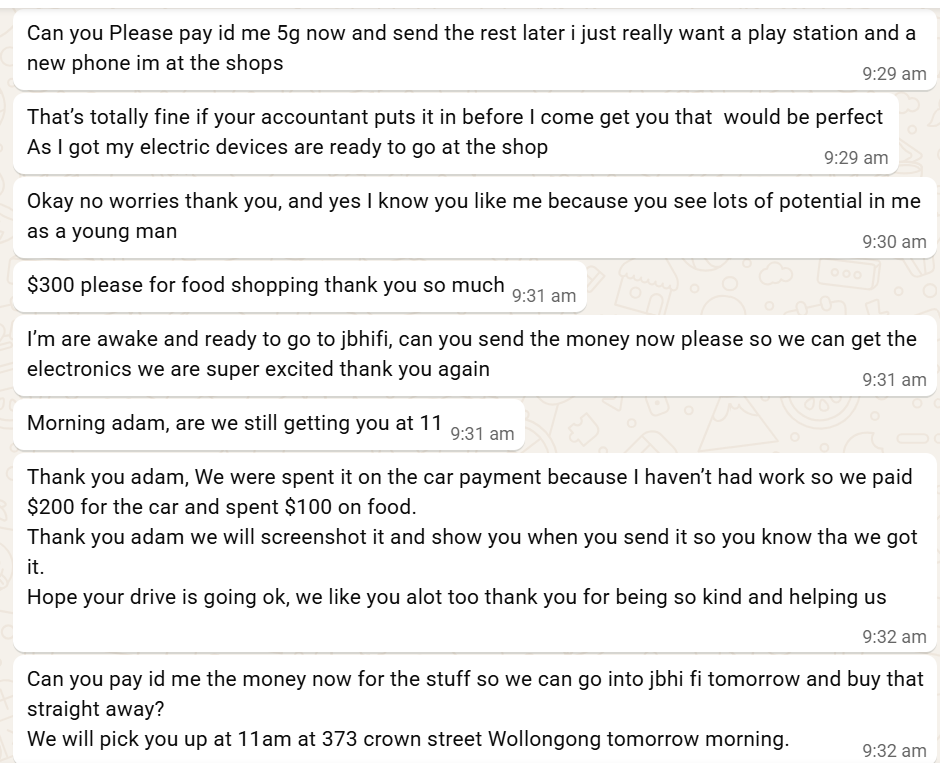
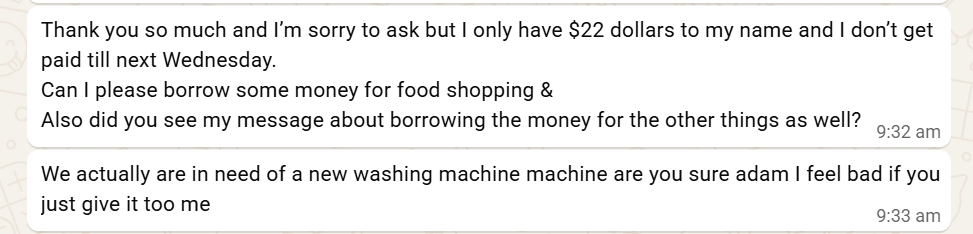
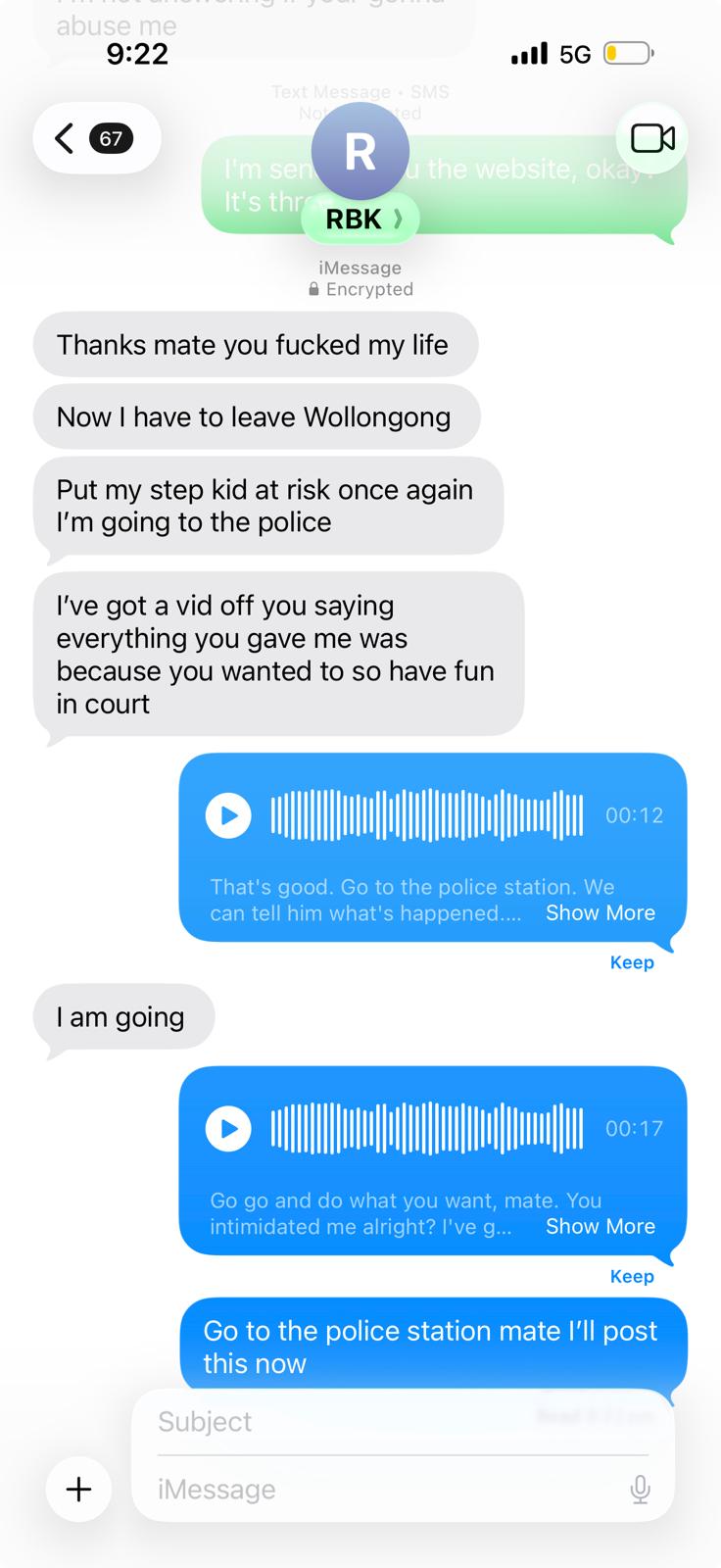
The Screenshots — The Exchange in Full
The messages are below. At one point, apropos of nothing, Rhys randomly sent a calculator — the kind of non-sequitur that tells you the conversation had stopped being about a video some time ago.
The Behaviour — Bite the Hand, Then Call the Cops
The pattern is its own story. The moment there was any disagreement, Rhys moved straight to threatening the police — while still wanting feedback on the video he was being paid to make. This is how you break a relationship and bite the hand that feeds you in the same message. A person is given an opportunity — paid work, a platform, someone who believed in him — and responds by taking the money, threatening the person who gave it, and reaching for law enforcement at the first sign of friction.
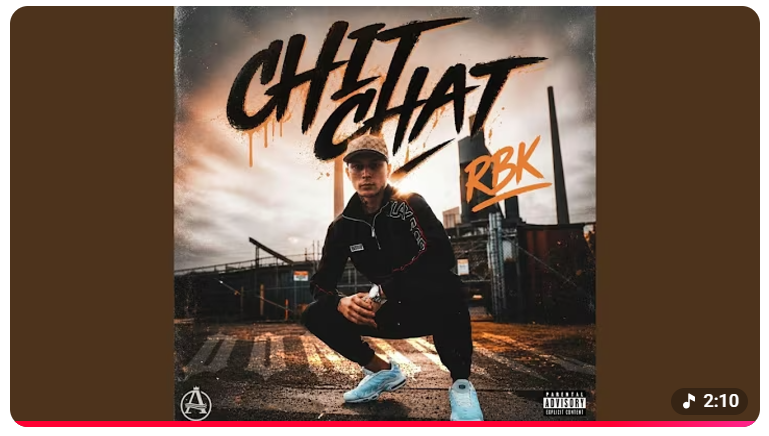
There is a particular irony to guys like RBK — a hard street image broadcast to the internet, right up until the first disagreement, when the phone comes out to dial triple-zero. His own song goes "chit chat, this, that — I don't want to talk about it." But the moment it suits him, he'll talk about it — to the police. Chit chat, this, that — straight to a statement. The street image says one thing; the conduct says snitch.
The Sympathy Play
Alongside the threats, Rhys has been flooding Adam's messages with lines like "I have to feed my daughter!" — the sympathy play, deployed on repeat. It is worth looking at that claim honestly. This is a man who has the time to make videos, who is wearing nice clothes in them, and who maintains a whole online persona — but whose stated priority, the instant money is on the table, is suddenly his child.
People like this invoke their kids as a lever, not as a compass. If feeding your daughter were genuinely the priority, it would show in the choices — not just in the messages sent to a man you are simultaneously threatening with the police. The child is real. The concern, deployed this way, is a tactic.
The Recorded Call — 373 Crown Street
"LET'S KEEP THIS BETWEEN US AND I'LL GIVE YOU WHAT YOU WANT."
Rhys called 373 Crown Street — a property Adam Watson owns — and the call was recorded. On that recording:
RBK: "Let's keep this between us and I'll give you what you want. If you're alone with me, what do you want to do with me?"
Adam: "Are you bisexual?"
RBK: "Yes."
RBK: "Why do you like me so much?"
Adam: "Because you've got tattoos and you're a bad boy."
Read in the cold light of the threats that followed, that exchange raises an obvious concern: setup and entrapment. "Let's keep this between us… if you're alone with me, what do you want to do with me?" — a person steering a conversation toward a private, compromising admission, on a call to a property he could later name, is exactly the shape a setup takes. With certain characters you meet through the internet and off the street, the friendly overture and the leading questions are not always what they seem. A recorded invitation to "keep it between us" can just as easily be the opening move of a shakedown as a genuine one.
The Entitlement — And the Opportunity He Burned
Adam is genuinely upset that Rhys is now calling him a "freak." It matters, because stigmatising someone — reaching for the words that mark a person as deviant or dangerous — is one of the most corrosive things you can do to them. It is a label engineered to make a person untouchable, and it is deployed here by someone who, moments earlier, was asking on a recorded line what Adam wanted to do with him.
There is a sadness underneath the entitlement. Adam gave Rhys an opportunity most people never get — paid creative work, a platform, someone who believed in him. He threw it away with both hands. One day his father is going to look back on all of this — on how his son treated the person who tried to lift him up — and understand exactly what was squandered. Entitlement always looks like strength in the moment. It reads as tragedy in hindsight.
The ThreatA Threat That Isn't One
"I'LL TELL EVERYONE ADAM LIKES BAD BOYS WITH TATTOOS."
Rhys's latest message threatens to "tell everyone Adam likes bad boys with tattoos." It is offered as leverage. It is nothing of the kind. Adam said exactly that himself — on the record, in his own words, on the recorded call above: "Because you've got tattoos and you're a bad boy."
You cannot expose a man who has already said it plainly. Adam is bi-curious and open about it; he has never hidden it, never denied it, and does not intend to start. A threat only works when the target is ashamed. There is nothing here to be ashamed of — which is precisely why the threat lands as what it really is: another attempt at pressure from someone who has run out of anything else to pull.
How It Ends — Police & Court"Now I Have To Leave Wollongong"
THE SAME MOVE, EVERY TIME: STRAIGHT TO THE POLICE.
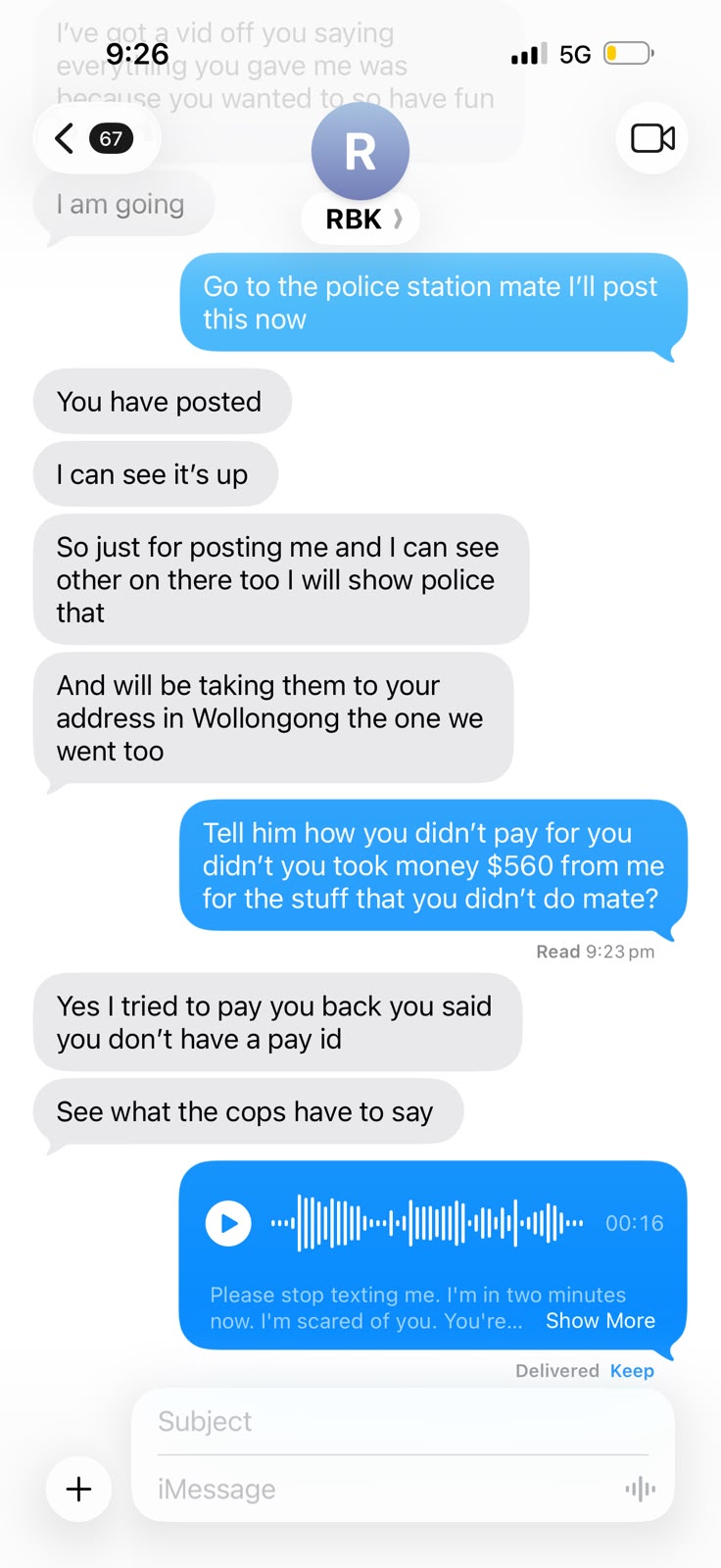
Once the record went up, Rhys's response was the one it has always been. He declared that Adam had "fucked his life" and that "now I have to leave Wollongong," then reached straight for the two levers he pulls whenever a situation stops going his way: the police and the courts. "I'm going to the police.""Have fun in court.""See what the cops have to say."
The tell is in the same breath. He threatens the police while conceding he took the money — his own excuse for not returning it is that Adam "didn't have a pay id." Adam's reply cuts to it: "Tell him how you took $560 from me for the stuff that you didn't do." Someone genuinely wronged does not have to rehearse which half of the story to show the police. Rhys does.
It is the same pattern set out at the top of this section — a hard image broadcast online, and triple-zero on speed dial the instant there is friction. Adam Watson's position has not moved: go to the police, go to court. The record is the record, and it stays up.
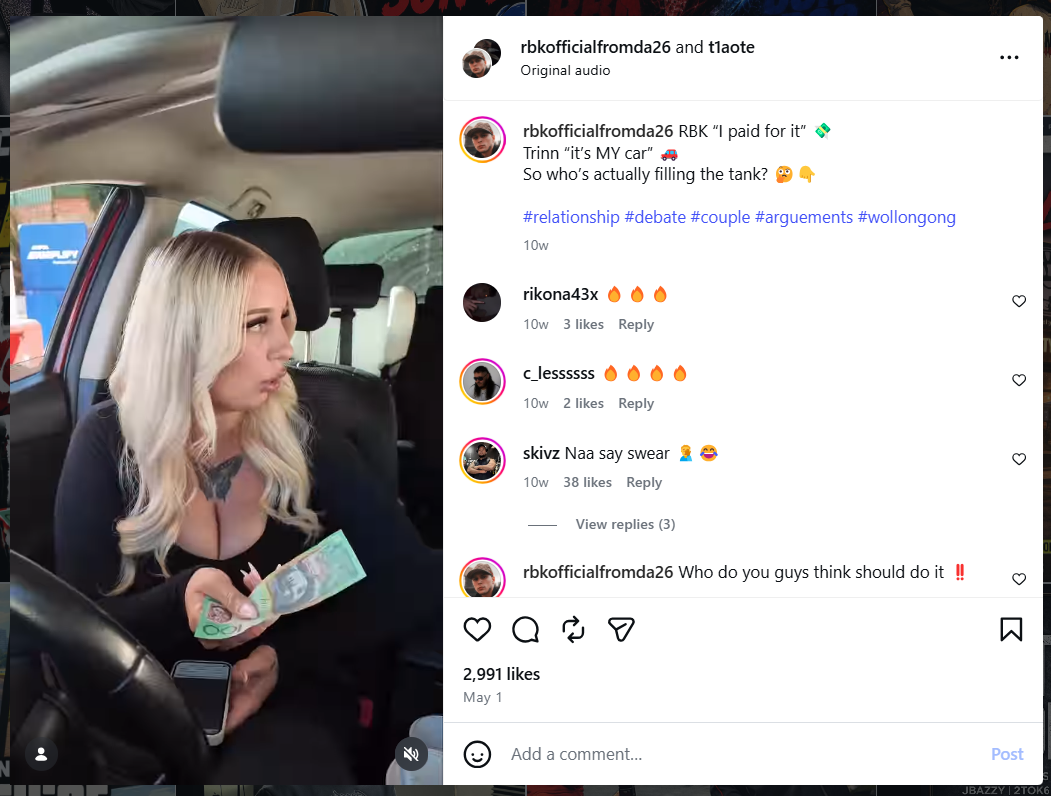
For the record, RBK promotes the following partners and sponsors on his Instagram channel:
The Accomplice — MyagiPressure to Take It Down
RBK'S FRIEND CAME TO SILENCE THE STORY — NOT TO ANSWER FOR IT.
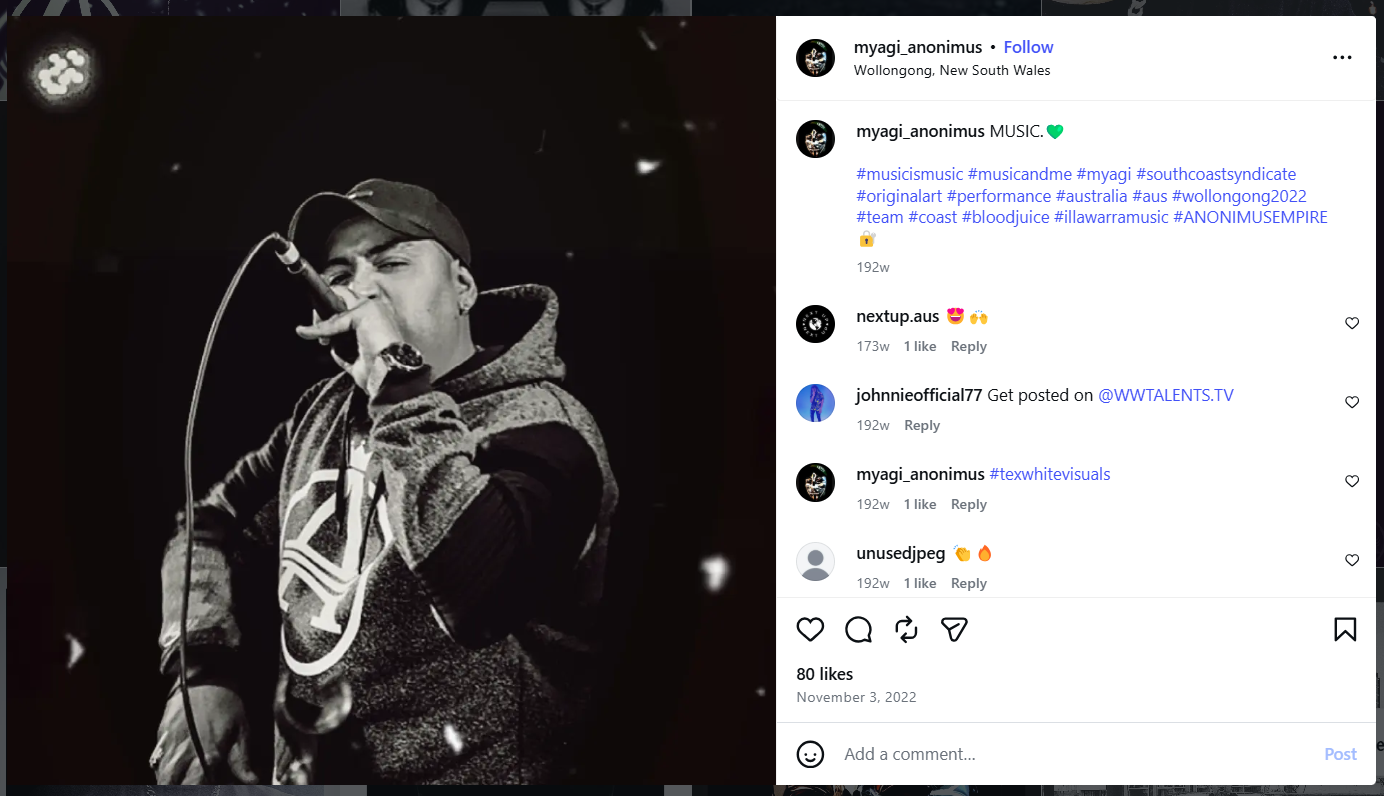
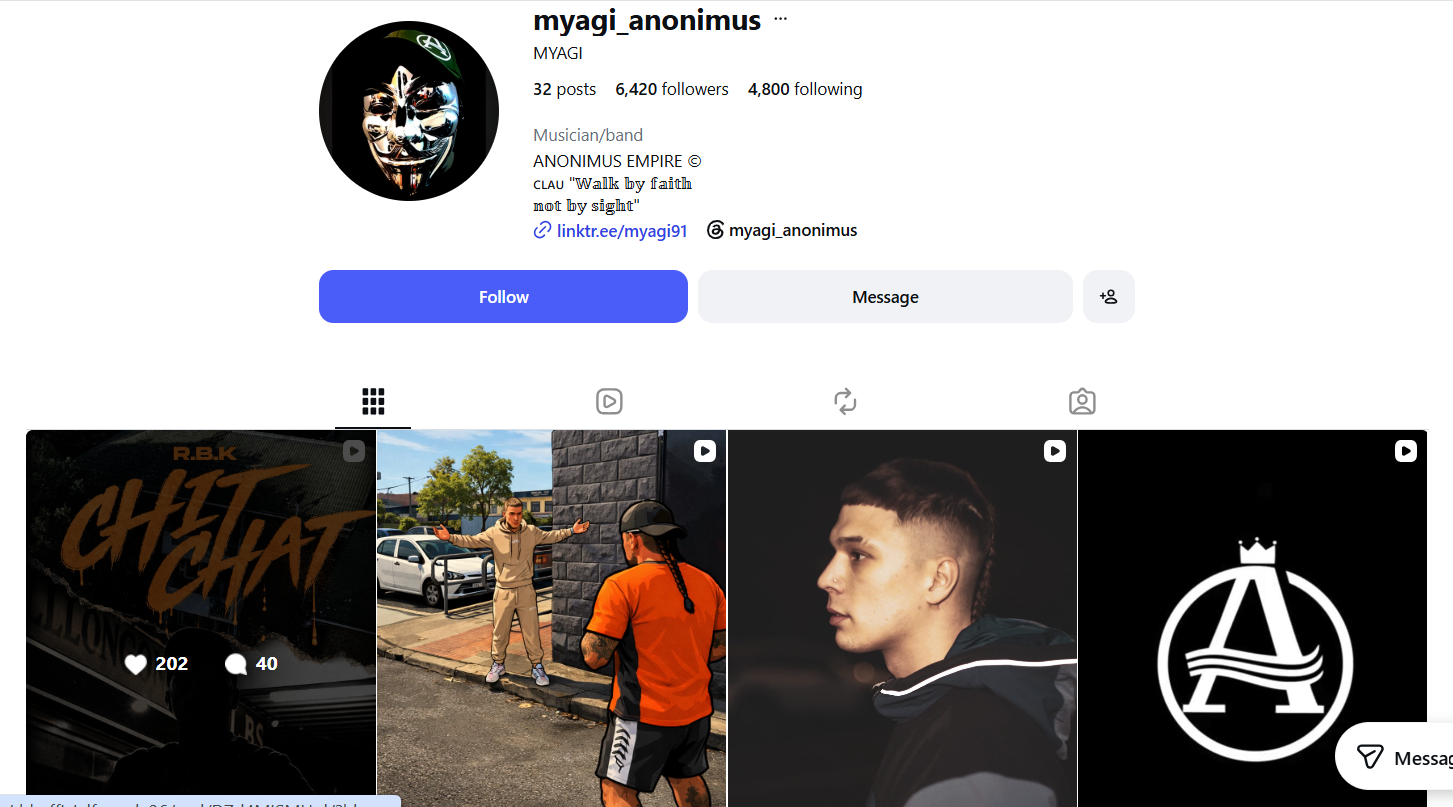
Myagi · @myagi_anonimus · Wollongong
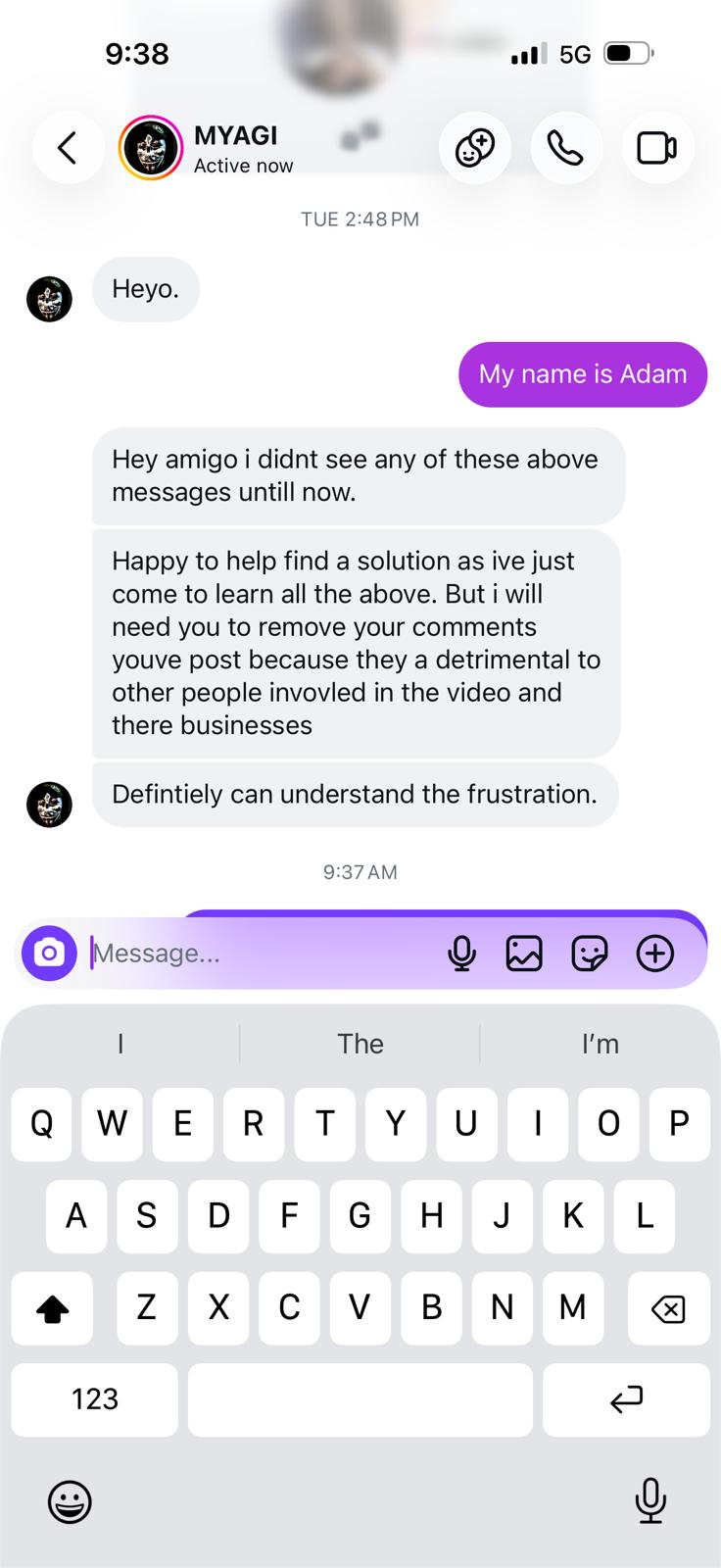
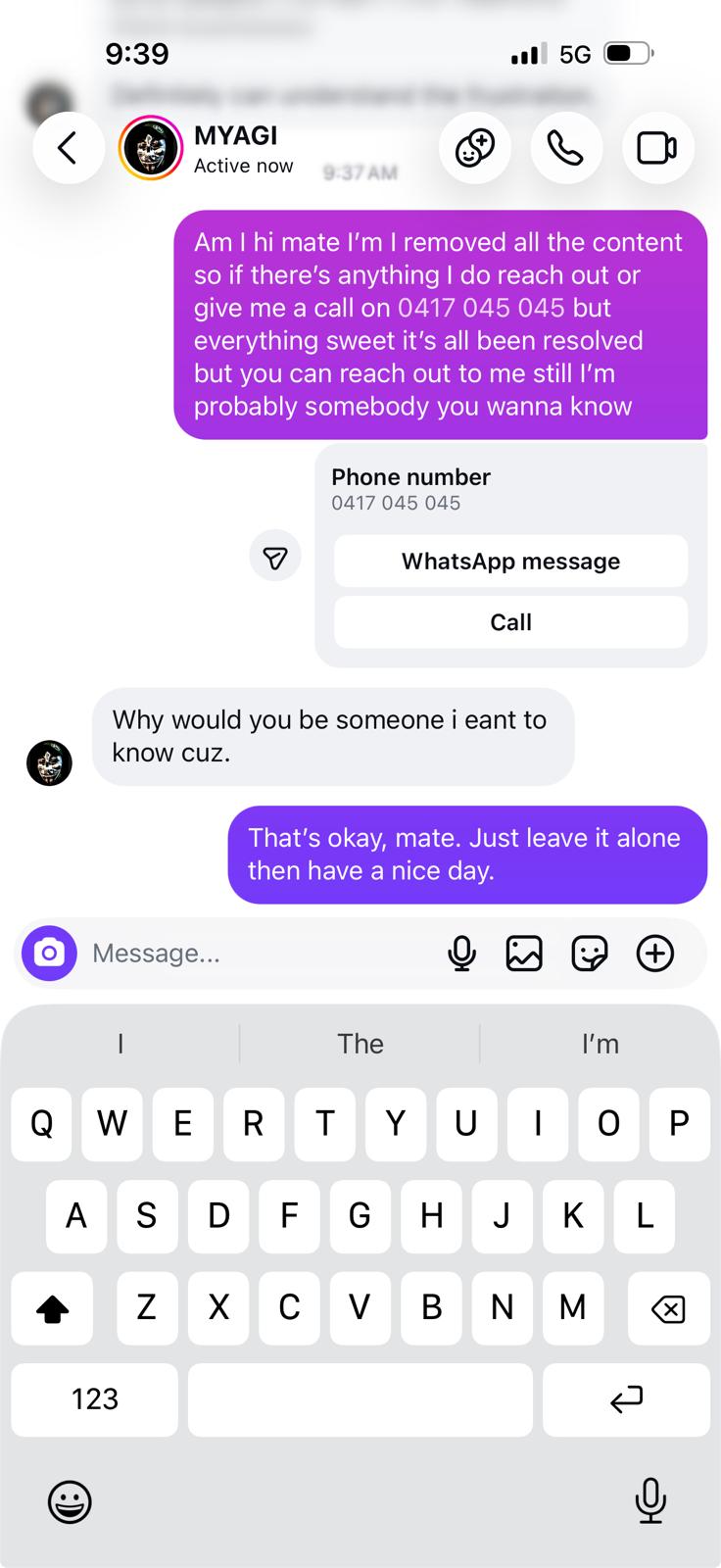
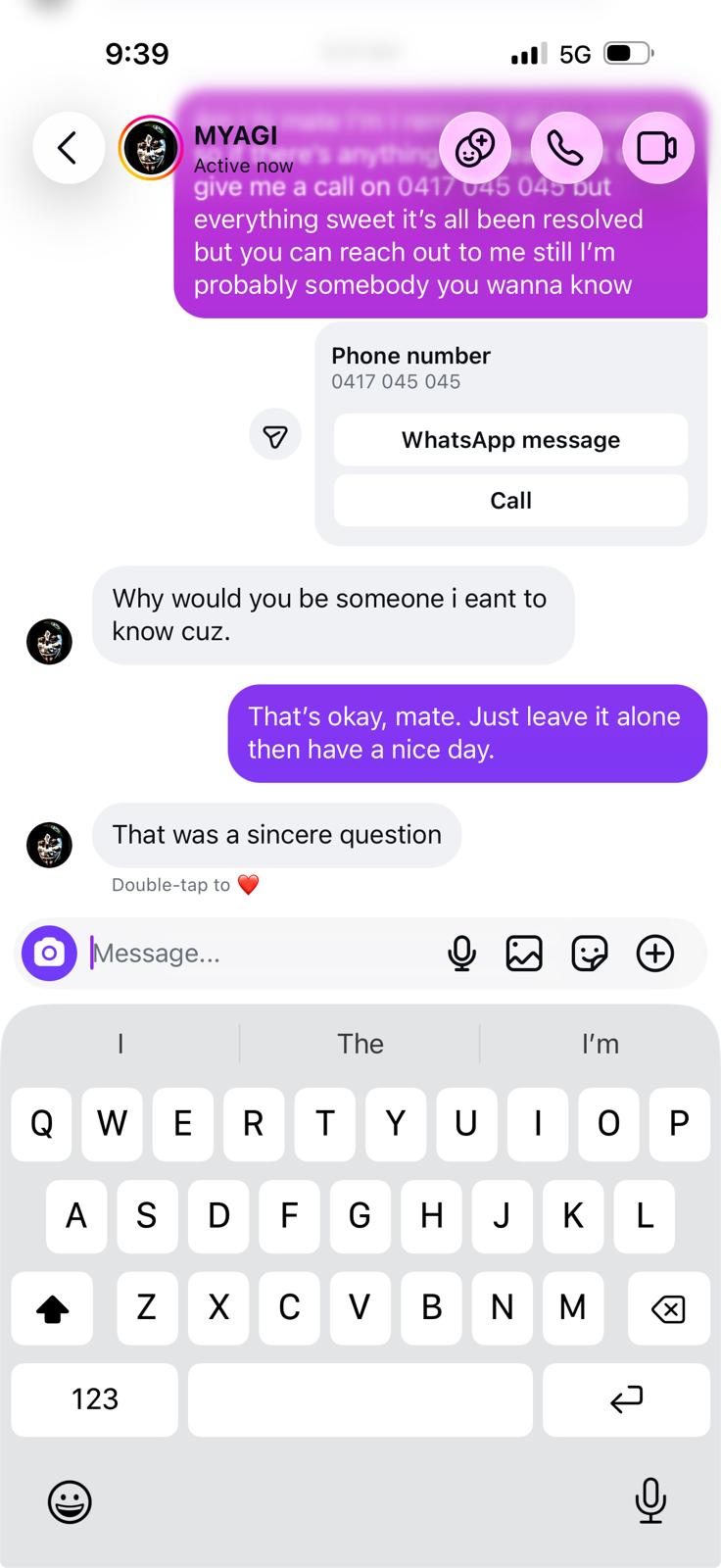
RBK's friend — a Wollongong rapper who goes by Myagi (@myagi_anonimus) — inserted himself into the matter. Not to address what his friend had done, but to pressure Adam Watson into taking the RBK material off Sunlight.Quest.
His stated reason is the tell. He argues the section should come down because it is a detriment to the businesses mentioned — the sponsors, the venues — while carefully stepping around the one fact that created the problem: his friend ran a scam. The businesses were not named to hurt them; they were named because RBK attaches himself to them. If there is a detriment here, its author is the person who behaved this way — not the person who documented it.
He then adopted an uptight, arrogant tone — as though Adam Watson were someone to be talked down to. It is worth remembering who Adam actually is: a genuine developer, the sole director and sole shareholder of the building at the centre of this episode. Coming in hot at a man of that standing, on behalf of a friend who scammed him, is a way of starting off on the wrong foot — and staying there. The messages are below.
The Affiliation — And What He's Really Covering
This is not a neutral bystander. Myagi's own Instagram promotes RBK directly — his page carries RBK's "Chit Chat" release, the very track quoted earlier in this section. The two are affiliated.
Which is what makes the intervention what it is. RBK is a police informant — the pattern documented across this section is the pattern of someone who reaches for the police the moment a situation stops going his way. Myagi is not defending an innocent man; he is running cover for a snitch and dressing it up as concern for local businesses. That does not launder. The record stays.
The Girlfriend's Message — The Pedophile Smear
RBK's girlfriend · From his Instagram
RBK's girlfriend also sent Adam Watson a message. Its purpose was to imply that Adam is a pedophile. It is worth naming that move for what it is, because it is so common it is almost a signature.
At the gutter end of any dispute, "pedophile" is the first reflex — reached for the instant a person has nothing real to say. It is thrown not because it is true, but because it is the ugliest word to hand. And there is a poverty of imagination underneath it: an inability to sit with the simple possibility that someone might just be kind — that Adam extended genuine help, paid work, and belief, with no sinister motive at all. People who have only ever operated in bad faith cannot picture good faith, so they rename it as the worst thing they can think of.
For the record: the implication is false. There is no allegation, no complaint, no substance behind it — only the word, deployed exactly the way people like this always deploy it.
The message · RBK's girlfriend to Adam Watson
The Smear, Taken to Adam's Client
MYAGI WENT TO 373 CROWN STREET TO POISON A BUSINESS RELATIONSHIP.
The smear did not stay online. Myagi went to 373 Crown Street — the property at the centre of Adam Watson's work — to speak to Robert Huang, Adam's client, and tell him that Adam is a pedophile who paid RBK for sexual favours. Both halves of that are false, and both are engineered to do maximum damage: attach the ugliest possible label, and reframe legitimate campaign work as something sordid.
He did not stop at the smear. In the same conversation, Myagi is reported to have told Robert Huang that he was going to throw Adam Watson out of the building, and made further threats — moving from character assassination to open intimidation, and aiming it squarely at the one commercial relationship most central to Adam's work.
This is where a smear stops being talk and becomes a deliberate attempt to destroy a livelihood. Walking into a person's business relationship to brand him a pedophile — over a disputed payment for a video — is not a grievance aired. It is a targeted effort to make a client cut ties, using the worst word available as the lever.
For the record, again: the payment to RBK was for a political campaign video — the receipts and the policy platform are documented above and in Episode 2. There were no "sexual favours." The pedophile claim is a fabrication. Carrying a fabrication like that to a person's client is exactly the conduct defamation law exists to answer — and Adam Watson is pursuing it.
The Card"You Have To Accept The Verification"
HIS CARD, ON THEIR PHONE. AND A MACBOOK ON THE WAY OUT.
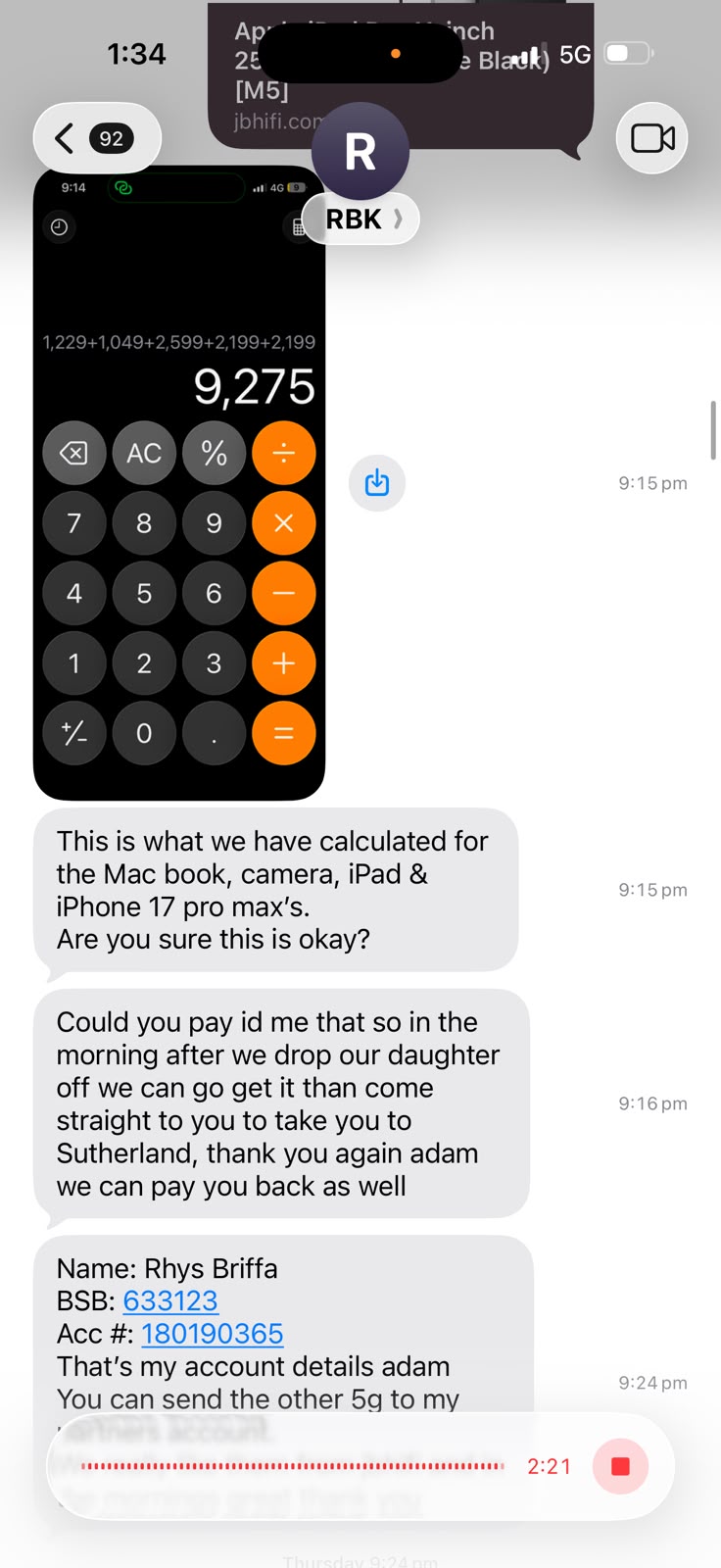
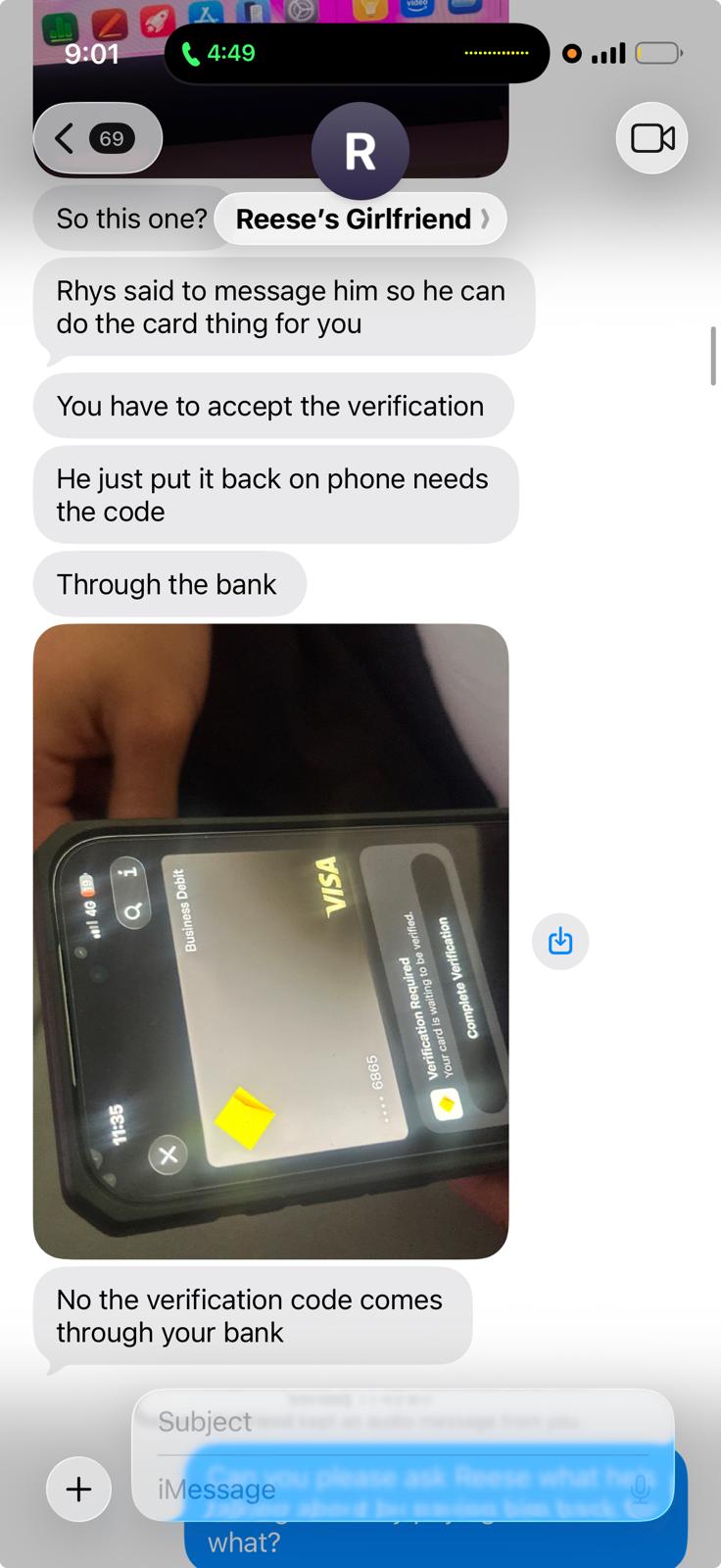
While the smears were flying, something quieter was happening with the money. RBK is said to have taken Adam Watson's card details from his phone without permission and loaded the card onto a device. What follows is a study in how this kind of scam actually runs.
RBK's girlfriend messaged Adam to get the card working: "Rhys said to message him so he can do the card thing for you,""you have to accept the verification,""he just put it back on phone needs the code." Then, when Adam did not play along: "That's completely fine adam, can I give you a call? ... I would feel more comfortable then you sending a photo" — followed by "I'll drive to jbhifi now." A JB Hi-Fi order for a MacBook was placed.
Look at the shape of it. The constant seeking of "verification" and reassurance — is this one ok?, you have to accept it — while the person whose card it actually is stays silent, is the signature of a scam that needs the victim's own hand to complete it. A genuine transaction does not require this much coaxing. The chasing is the tell.
Coordinating the card "verification" · Adam's card, last 4 digits only
The Tattoo Shop — Full Circle
One of the venues attached to RBK — the tattoo studio listed among his sponsors above — has its own story running underneath this one. Many of its people have quit. And rather than sit with why, the shop is said to have gone to the underworld for retribution over the exposure.
That is a category error. You cannot run to the underworld to complain that someone exposed a snitch. It does not work that way — that world's own code has no sympathy for informants, and an appeal made on a snitch's behalf has a way of coming back on the person who made it. It has come full circle. There is a great deal more to this that sits in the background and cannot be set down here — but the shape of it is simple: the people trying to bury this story keep arriving at the same door, and the door keeps opening the wrong way for them.
The Video Guy — Skivz"What's It Got To Do With Me?"
THE MAN BEHIND RBK'S CAMERA — AND A SLOGAN THAT DOESN'T SURVIVE CONTACT.
Skivz · @skivz · Wollongong
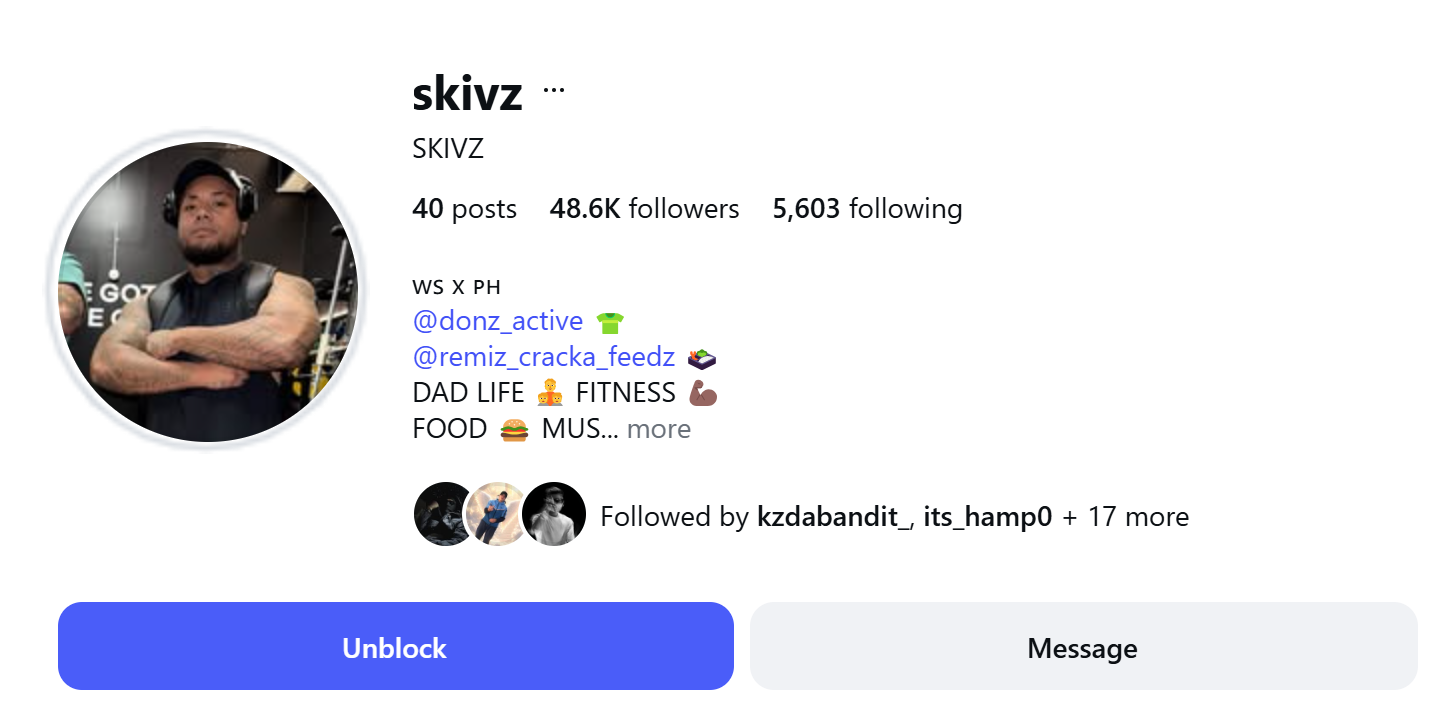
RBK's videos are made by a man who goes by Skivz — RBK named him directly as the person who films his content. On Instagram (@skivz) he carries a following in the tens of thousands and brands himself around "Dad Life," fitness, and discipline.
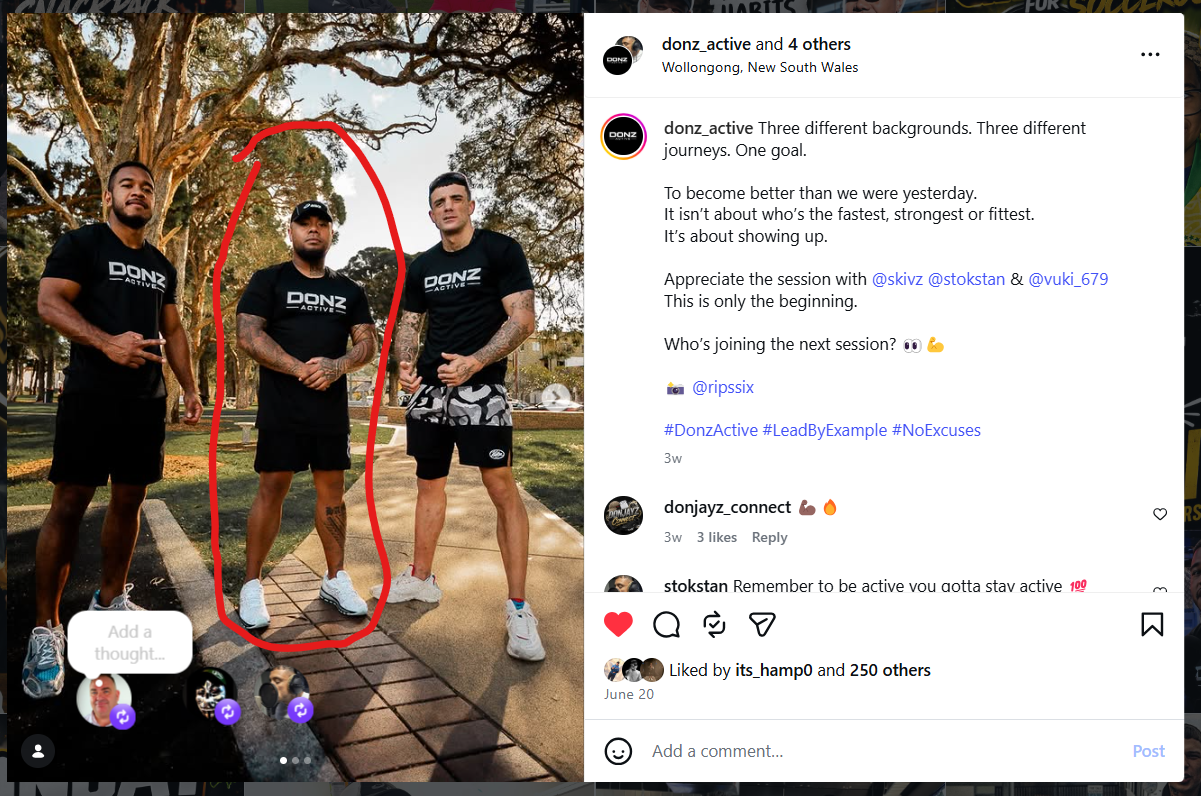
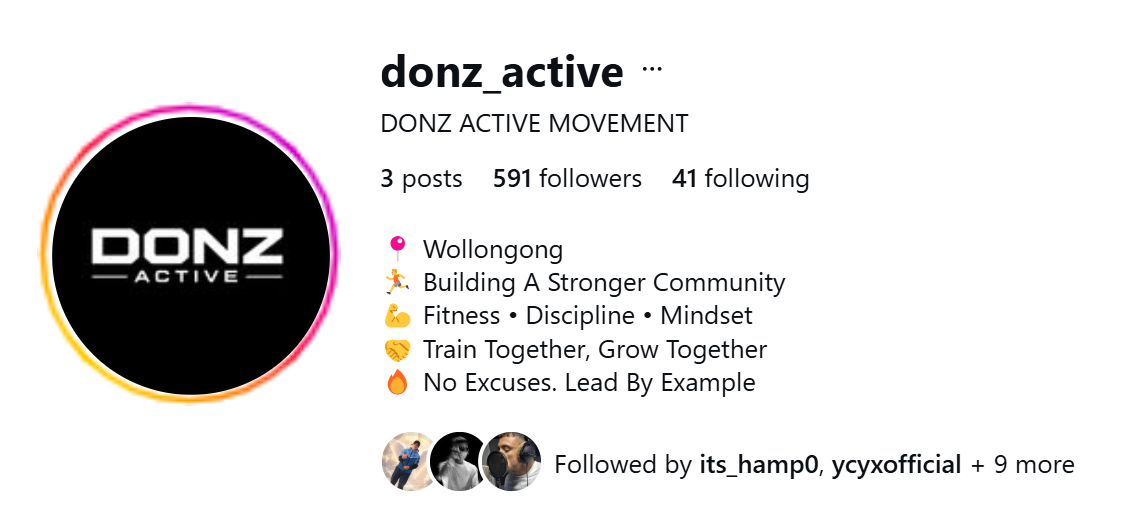
He is closely tied to Donz Active — a Wollongong fitness and clothing label he promotes, tagged into its posts under the banners "No Excuses,""Discipline · Mindset," and the one that matters most here: "Lead By Example."
Donz Active markets itself on "Building A Stronger Community,""Fitness · Discipline · Mindset," and "No Excuses. Lead By Example." They are good words. The only real test of words like that is what happens when they meet something inconvenient.
Adam Watson raised with Skivz that a young child in his family was being placed in and around RBK's videos — RBK being the person documented across this section for what looks, on the evidence, like a scam. The conversation was recorded. Skivz's answer speaks for itself.
"...so what's it got to do with me?"
— Skivz, to Adam Watson (recorded)
Recording · Adam Watson & Skivz
The recorded call in which Skivz — asked about the child being placed around RBK's videos — answers "what's it got to do with me?"
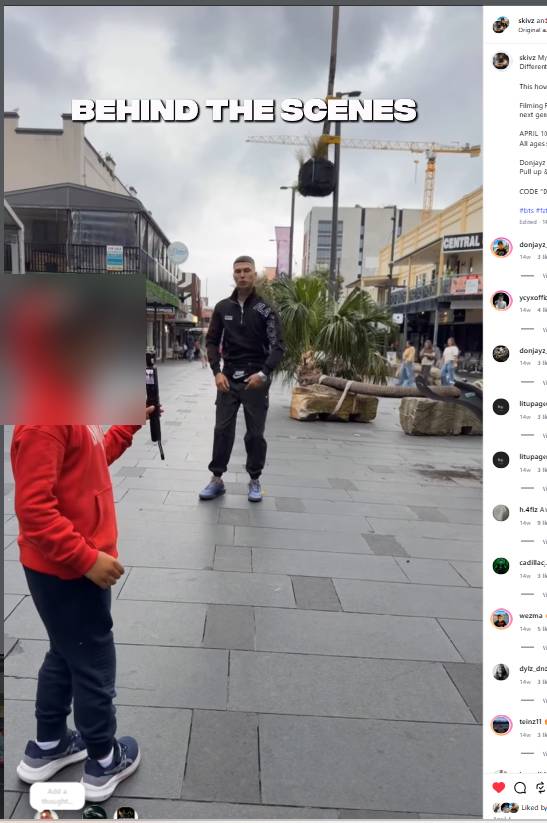
Behind the scenes on an RBK shoot — a child working the camera. Face redacted to protect the minor.
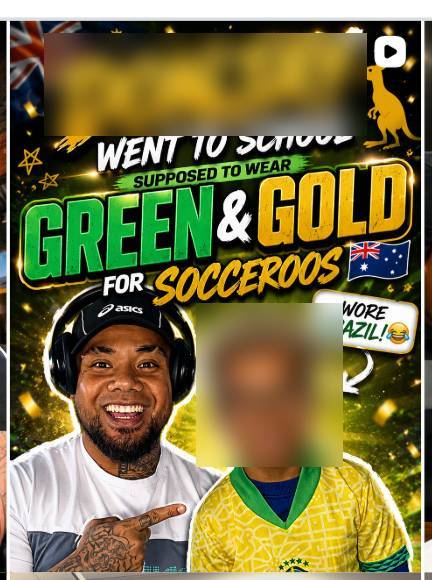
Skivz puts his child front-and-centre in his own content — the same child whose presence around RBK's videos he waved off with "what's it got to do with me." Name and face redacted to protect the minor.
On the law, and on affiliation: filming for someone, or promoting them, does not by itself make you a party to their conduct — association is not liability. But it is not nothing, either. Endorsement carries weight — it is the entire reason a brand pays for it — and where a promotion helps push a misleading arrangement, consumer-protection law can reach the promoter, not only the principal. That is the legal edge of it, and it is worth knowing.
The simpler point needs no lawyer. A label built on "Discipline, Mindset, Lead By Example," fronted by a man who brands himself on "Dad Life," is either a set of values or a marketing costume. Told that a child was being drawn into the orbit of someone accused of a scam, "what's it got to do with me" is the answer of the costume — not the example.
For the Record — What the Payment Actually Was
The money Adam Watson paid RBK was payment for a video for Adam's political campaign — the policy platform set out in Episode 2 (Adam's policies). It was a straightforward commercial engagement for legitimate work, not the arrangement RBK and his circle have since tried to paint. The "scammer" line runs in exactly one direction — and it is not the one they are pointing.
Adam Watson is threatening legal action for defamation over the false characterisations being spread about him.
The Receipts — Adam Watson → RBK (Shown to Skivz)
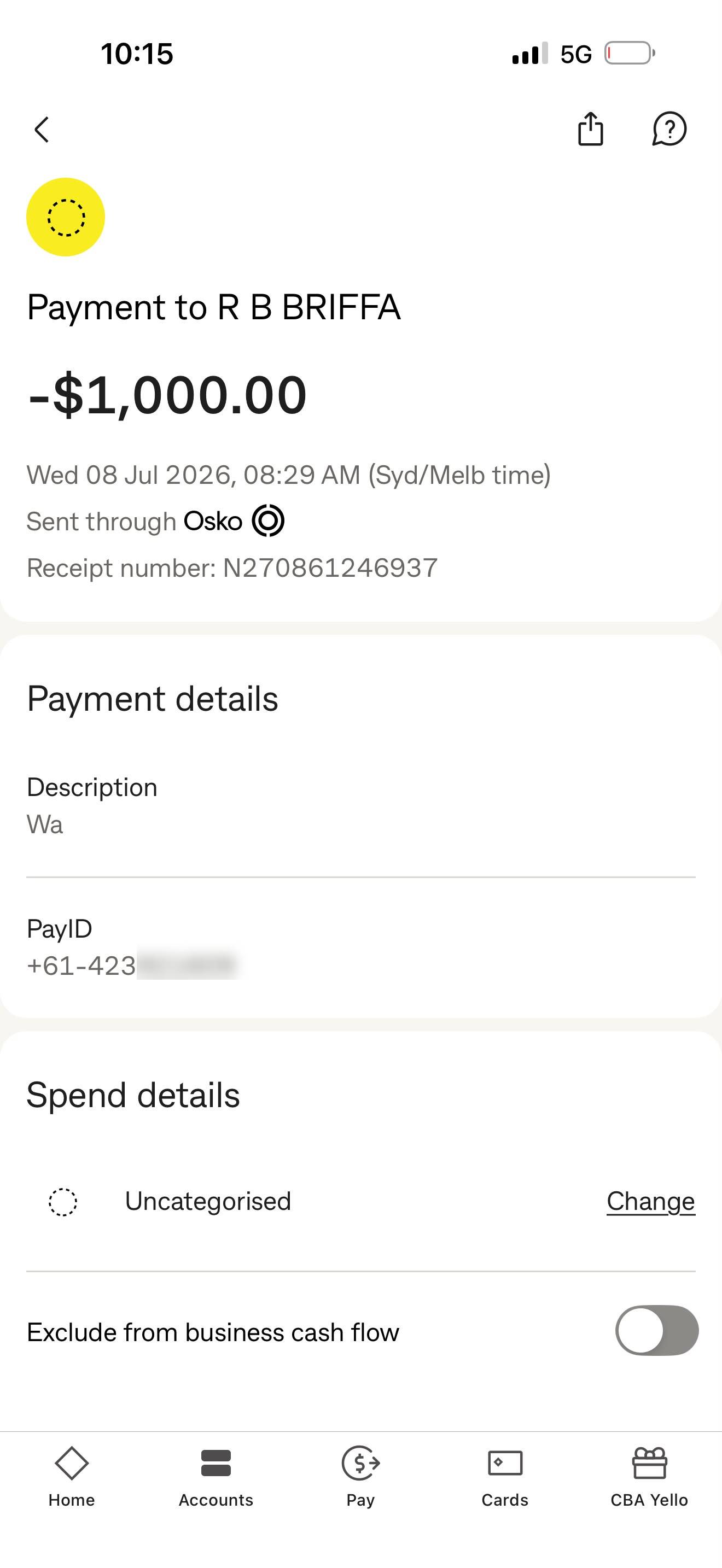
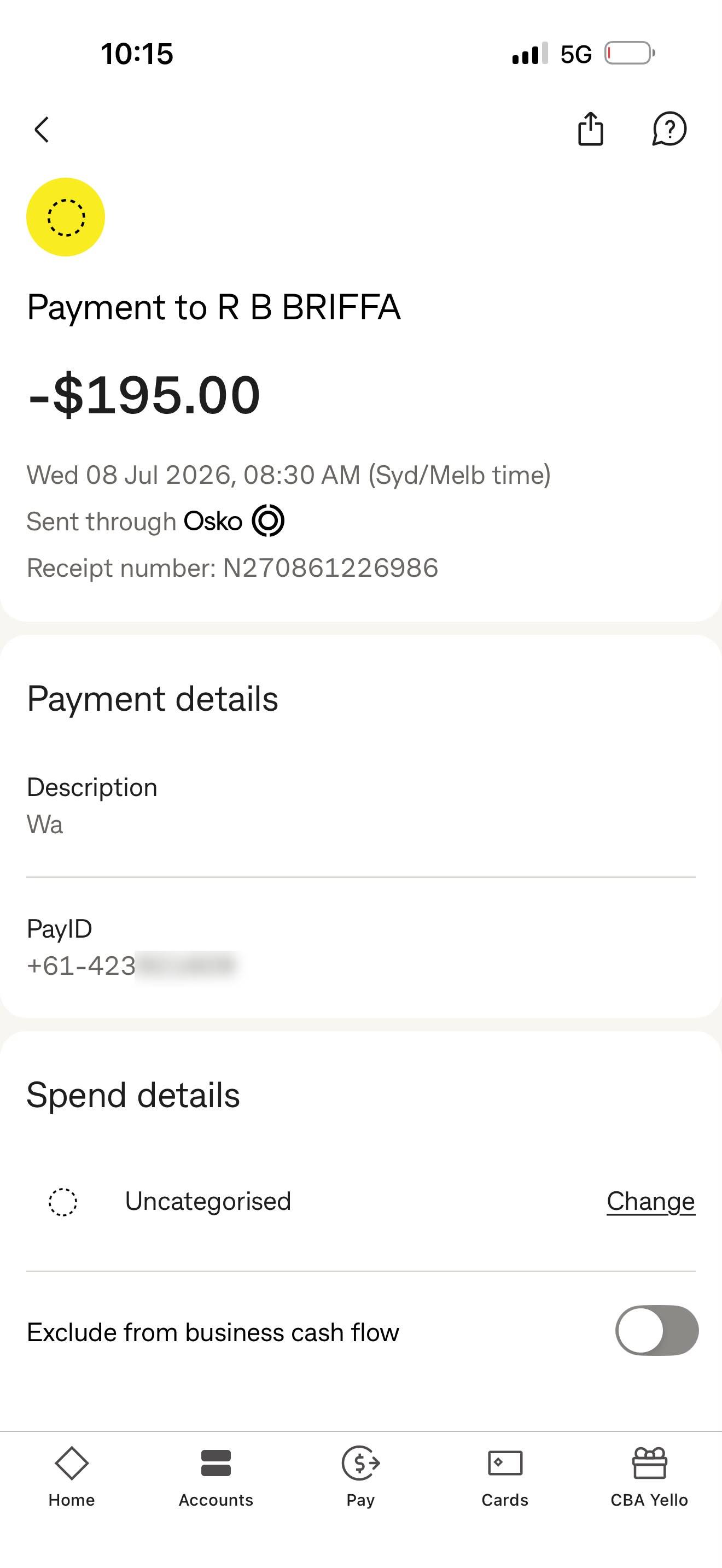
The two Osko transfers Adam sent RBK for the campaign video — $1,000 and $195, $1,195 in total. These are the receipts Adam put in front of Skivz. The payee's PayID mobile number has been redacted — a private number is not ours to publish.
Payment to R B BRIFFA · −$1,000 · Osko · Rcpt N270861246937
Payment to R B BRIFFA · −$195 · Osko · Rcpt N270861226986
A CHILD, USED AS PROMOTION FOR A ROMANCE SCAM. NOW REPORTED.
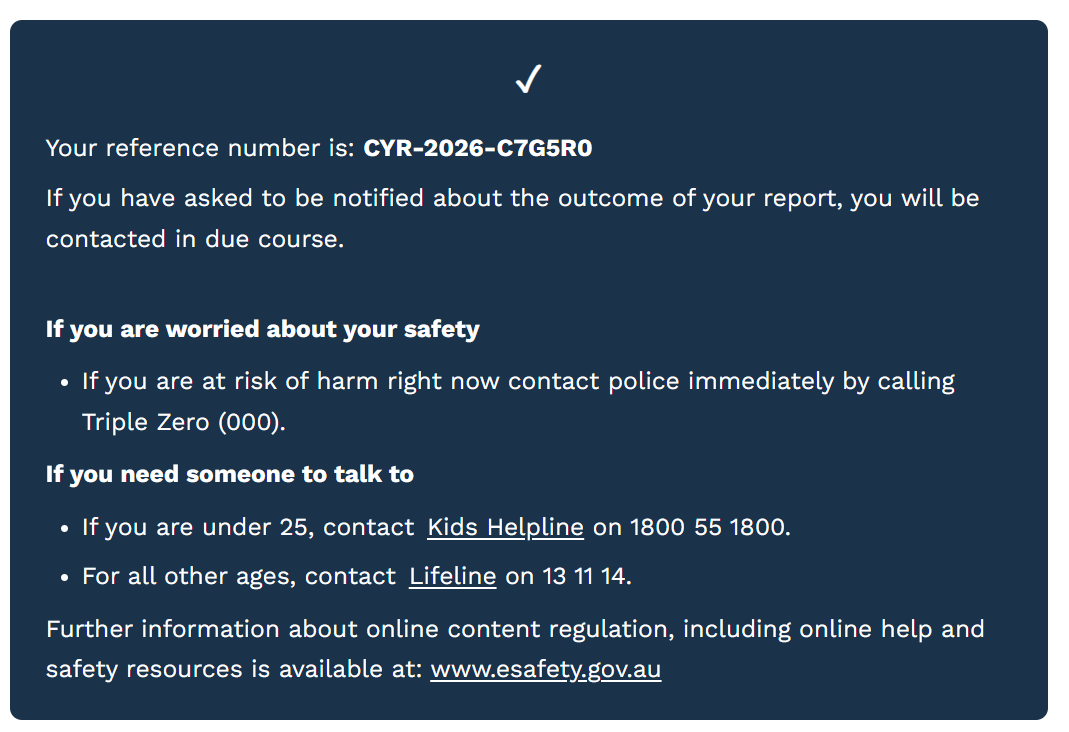
A formal complaint has been lodged with Australia's eSafety Commissioner about these Instagram accounts — @rbkofficialfromda26, @skivz and @donz_active — and about the conduct set out across this section.
The heart of the complaint is a child. Skivz promotes his young son through his platform while placing him in and around content tied to RBK — conduct that, taken as a whole, has the hallmarks of a romance scam run against Adam Watson. A child is not a prop for that. Whatever the adults are doing to one another, drawing a minor into it is its own harm — and it is exactly the kind of thing that belongs in front of a regulator.
The report has been acknowledged under reference CYR-2026-C7G5R0. The confirmation is shown alongside.
Section 01 — The Consent OrderCase 2025/00005577 · 1 August 2025
A PROMISE THE GOVERNMENT MADE TO A COURT.
"In August 2025, the NSW Land and Housing Corporation did not lose a case. It agreed to one."
1 Aug
Consent order
2025
$77.95
Rent cap / week
Until repairs done
1 Nov
Repair deadline
2025 — passed. Not done.
$291
Compensation
Ordered at tribunal
By consent, the NSW Civil and Administrative Tribunal recorded that the agency — the state body that houses some of the most vulnerable people in New South Wales — would, by 1 November 2025, treat and remediate the mould throughout a South Coogee social-housing unit, repaint the internal walls, fix a leaking lounge-room ceiling, and complete a short list of other repairs.
Until that work was done, the Tribunal capped the rent at $77.95 a week, and ordered the agency to pay the tenant $291.80 in compensation. The tenant was given leave to come back if the work wasn't finished.
That is not an allegation. It is a sealed order of a tribunal, made by consent, and you can read it in the evidence vault below.
The deadline came and went. The work was not done.
Section 02 — The Adjournment Sequence
NINE MONTHS OF "WE'LL GET TO IT."
What the documents show next is a slow, documented drift — the sound of an order with no one to enforce it.
Documented Timeline — Case 2025/00005577 · 2026/00090755
6 Feb 2025
Rent reduction put in place
A rent reduction is put in place over the condition of the property.
1 Aug 2025
Consent order made
By consent, NCAT orders LAHC to remediate mould and complete repairs by 1 November 2025; rent capped at $77.95/week until done; $291.80 compensation ordered.
1 Nov 2025
Repair deadline passes
The deadline passes. The work is not done.
4 Mar 2026
Fresh application lodged
Tenant lodges a fresh application to enforce the order (Case 2026/00090755).
15 Apr 2026
Landlord fails to appear
The landlord doesn't turn up at all. The Tribunal sets the matter down for conciliation.
1 May 2026
"The landlord is inspecting"
Adjourned because the respondent landlord is inspecting. Six months after it promised a court the work would be finished, the agency is still sending someone to look at it.
17 Jun 2026
Power fails
The unit loses power. The property is a registered life-support address. Ausgrid had previously flagged a faulty main switchboard and directed it be replaced.
18 Jun 2026
Another adjournment
Matter adjourned again, by consent.
26 Jun 2026
Rent billed at $520 — urgent application lodged
Rent billed at $520/week and the full amount taken from Centrelink. Urgent NCAT application lodged. Demand letter sent to the Minister.
In March 2026, the tenant did exactly what the order allowed and lodged a fresh application. In April, at the first listing, the landlord didn't turn up at all; the Tribunal noted the tenant was entitled to bring his claim for the ongoing defects and set the matter down for conciliation.
By 1 May 2026, the file records an adjournment for a reason that says everything: the respondent landlord is inspecting. Six months after it had promised a court the work would be finished, the agency was still sending someone to look at it. In June, the matter was adjourned yet again.
Each step is on the record. Each step is another month a family lived with mould the agency had been ordered to remove.
Power fails at the premises. Not a billing issue — a physical supply failure at a registered life-support address.
Ausgrid Note — Ref. 66693
Ausgrid previously flagged a faulty main switchboard serving the block, directed the housing electrician to replace it, noting life-support customers in the affected units.
Never Replaced
The responsibility to carry out the permanent repair sat with the landlord's electrician. According to the tenant, it was never done, and the supply failed.
The property is a registered life-support address. We know this because of a note left by Ausgrid, the electricity distributor, for the housing electrician (Ausgrid reference 66693, reproduced in the evidence vault below). It records that the main switchboard serving the block has a faulty contact, directs that it be replaced, and notes that the affected units — including this one — were temporarily re-routed "due to life support customers." The responsibility to carry out the permanent repair sat with the landlord's electrician. According to the tenant, it was never done, and the supply failed.
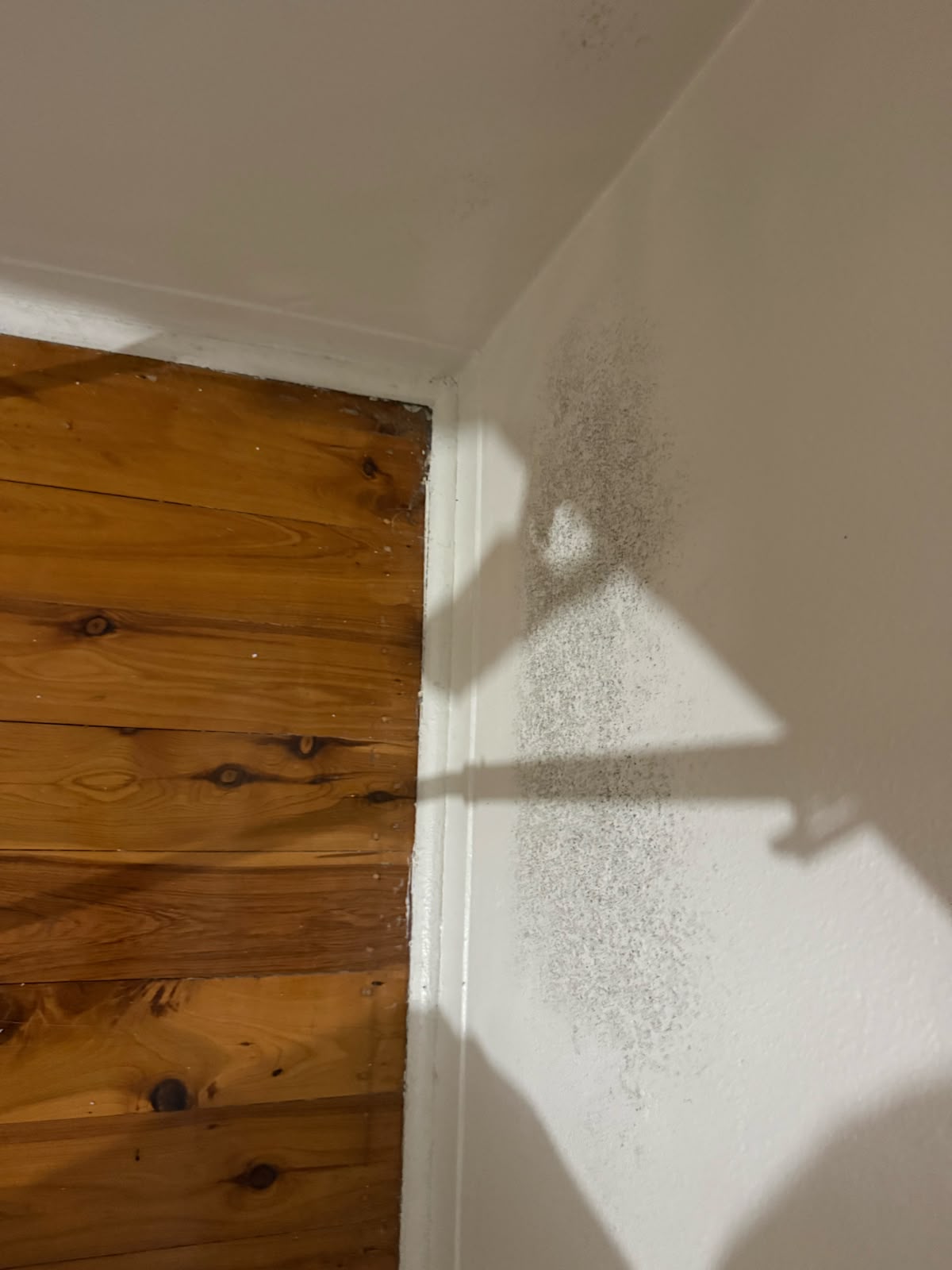
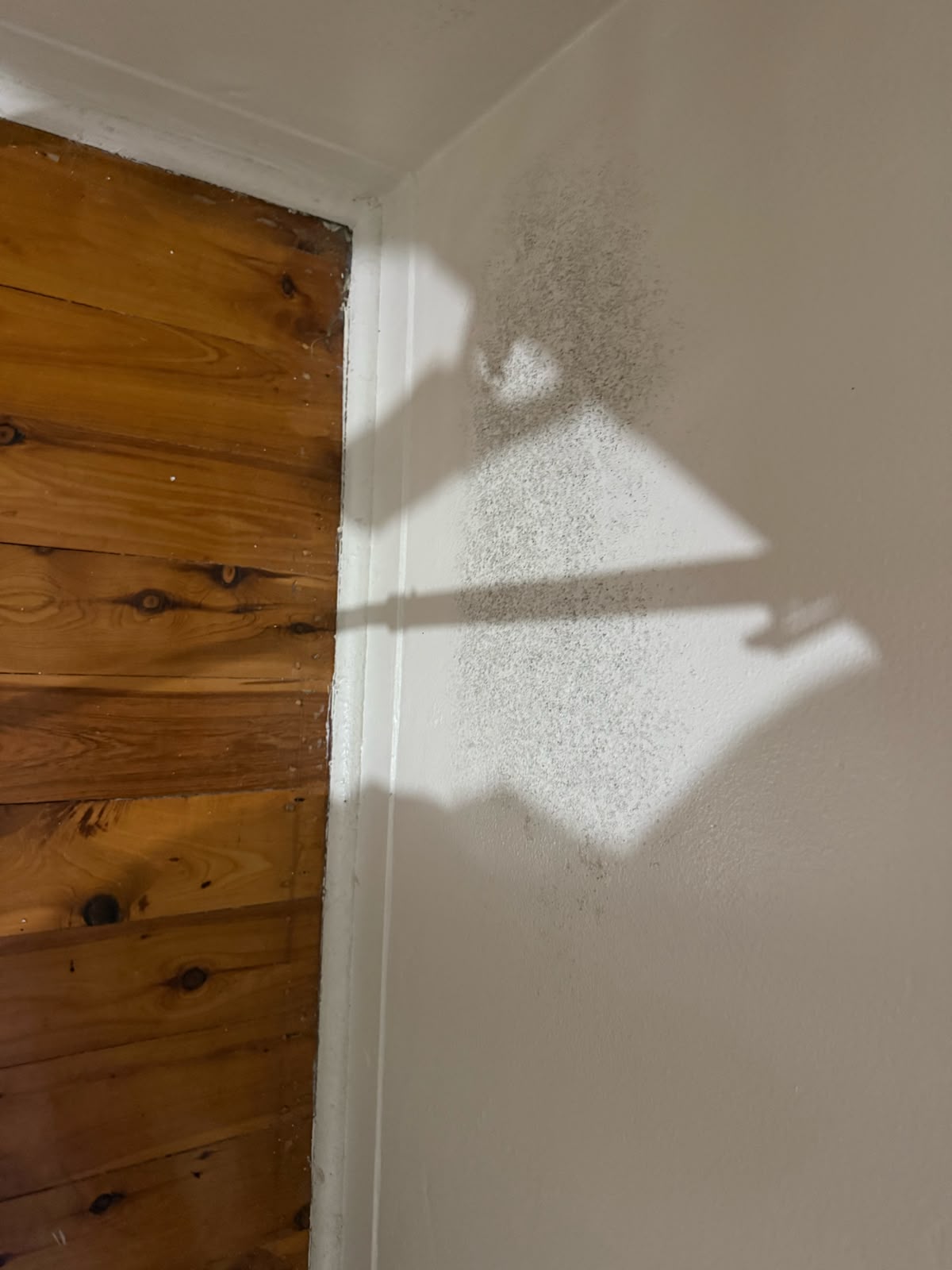
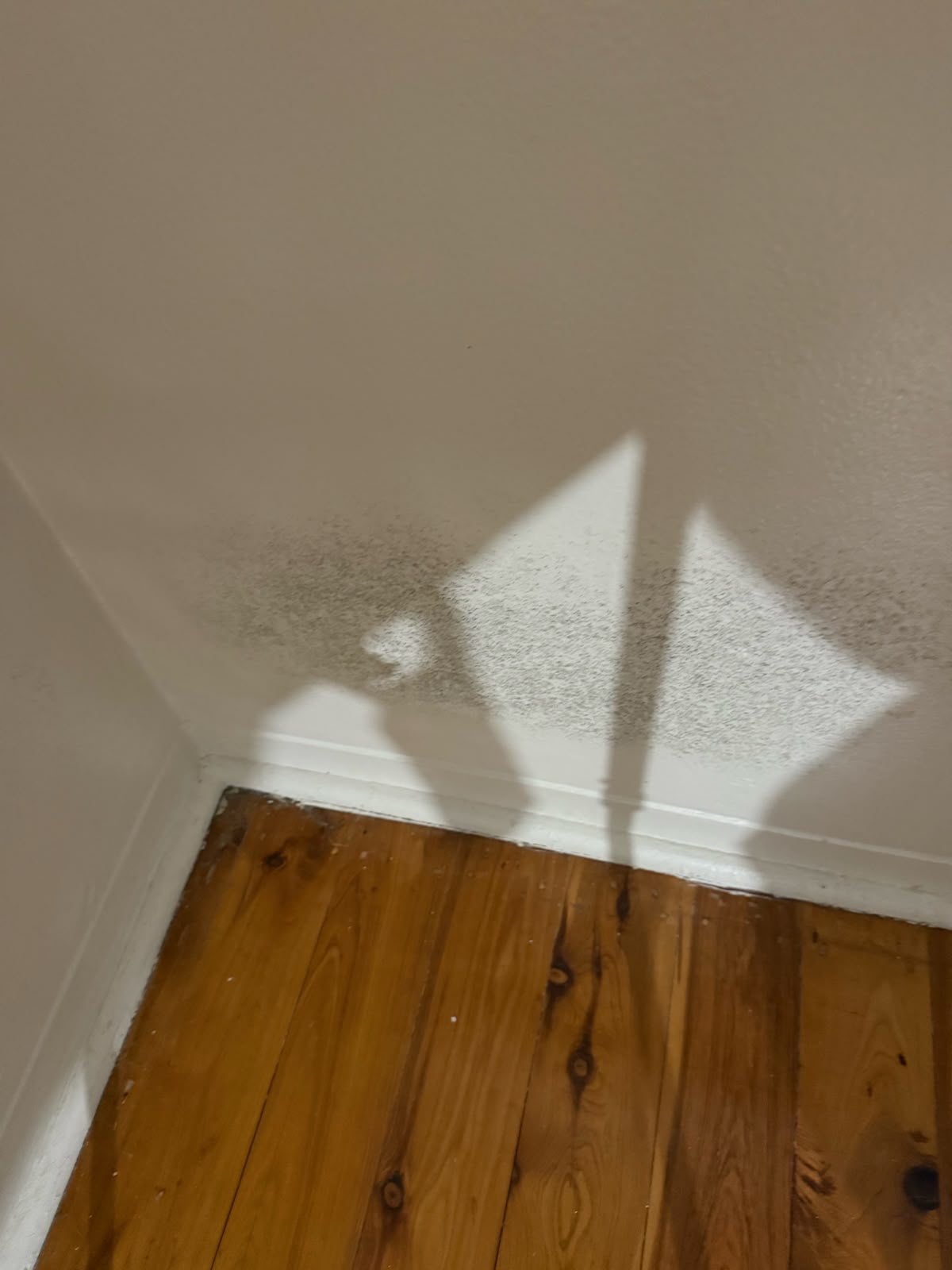
A household member is diabetic. The mould the agency was ordered to remove a year ago was, the tenant says, simply painted over rather than treated — and it has bled back through the paint, as the photographs show.
Exhibit 1 of 3 · Click to expand
Exhibit 2 of 3 · Click to expand
Exhibit 3 of 3 · Click to expand
Mould on painted wall and ceiling surfaces — present despite a consent order requiring remediation by 1 November 2025. The tenant says the mould was painted over rather than treated and has bled back through.
Section 04 — The Rent
AND THE RENT WENT TO $520.
"Here is the part that should stop a Minister in her tracks."
The Rent Sequence — What Happened
Ordered capTribunal order: rent capped at $77.95/week precisely because the repairs were outstanding.
Standard rateThe ordinary subsidised charge for the tenancy: around $137 plus $8 for water — roughly $145/week.
Billed 26 JunWith the repairs still outstanding and the tribunal order still in force, the agency billed the tenant $520 a week on a single day's notice.
Centrelink seizedThe entire $520 amount was taken from his Centrelink payment. The tenant says this left the household with no income at all. Centrelink suspended payments to protect him.
$77.95
Tribunal cap
Per week — court ordered
~$145
Standard subsidy
$137 + $8 water
$520
Billed on 26 Jun
One day's notice. Full Centrelink seized.
Whichever figure you use, the contrast is the same: an agency that pleaded poverty of performance to justify a rent cap was, months later, taking nearly everything a tenant had.
An agency that was ordered to cap rent at $77.95 because its repairs were overdue billed $520 — with the repairs still overdue — and took the entire amount from his Centrelink payment on a single day's notice.
Update — $1,040 Taken in One Week⬤ RETALIATION
NOT $145. $1,040 — IN A SINGLE WEEK.
The tenant is paid weekly. Instead of taking the standard ~$145 for the week, the agency took $1,040 in one week — two weeks' worth at once. As at 28 June 2026, that means he loses his payment last week and this week. For two weeks the tenant will have no money at all.
There is no benign reading of this. It was done as retaliation. A Centrelink assistant saw what had happened and stepped in — attempting to get Housing NSW to back down and reverse the seizure.
The $1,040 was taken directly from the tenant's Centrelink payment
The Glaring Issue
Housing NSW is able to penalise a person by reaching in and taking their full Centrelink payment — the entire income of someone in social housing — and leaving them with nothing to live on. That a government housing agency can zero out a vulnerable person's only income, and do it as retaliation, is a structural failure. Rose Jackson, the Minister for Housing, is aware of this.
Section 05 — Accountability
SO WHO IS ACCOUNTABLE?
This is where the consequence economy is supposed to do its job — and doesn't.
The Minister — Rose Jackson
Rose Jackson — Australian Labor Party
Rose Jackson · Minister for Housing
Labor Minister. The NSW Land and Housing Corporation now sits within Homes NSW — within her portfolio.
The Minister responsible is Rose Jackson, the Minister for Housing. The NSW Land and Housing Corporation now sits within Homes NSW, which is within her portfolio. Under the most basic convention of responsible government, the conduct of that agency is the Minister's to answer for.
She does not personally schedule a plumber — but she is the person the public is entitled to hold to account when the agency she is responsible for ignores a court order and leaves a life-support home in the dark. The tenant has written to her office.
The Position of This Masthead
When a private citizen ignores a court, there are consequences. When a state housing agency ignores a tribunal it agreed to be bound by, the file simply gets another adjournment. There is no one whose job it is to make the order bite. He is owed an answer, and so is the public.
The Excuse — Already Blaming the Contractors
Rose Jackson is already reaching for the standard defence — blaming the contractors and scheduling availability. But this has been going on for two years. No one is going to take seriously the suggestion that a tradesperson's calendar is the reason a consent order has gone unmet, the power has failed at a life-support address, and the rent has been pushed to $520 — for two years. Contractor availability does not explain two years of inaction. It is the explanation a Minister offers when she has no other.
Adam Watson — Why It Really Takes This Long
THE REAL REASON A SMALL JOB TAKES TWO YEARS.
Adam Watson says the delay is not really about any one tradesperson's calendar. It is about who is permitted to work on government contracts in the first place. In his account, the CFMEU controls who works on government contracts — and once a small repair has to pass through that gate, even a minor change drags out for months or years. The contractor "availability" Rose Jackson points to is downstream of who is allowed to hold the contract at all.
Adam Watson goes further: he says Labor allows Mick Gatto to control all the contracts — the same Mick Gatto documented in Episode 2. On this account, the control of the contracting pipeline is exactly why a consent order to fix a single home can sit unmet for two years.
Adam Watson's Position
Adam Watson states that if the Liberals get into Victoria, Mick Gatto will go to jail for 20 years — and that right now he is probably moving all of his assets ahead of that. Labor, in Adam Watson's view, is allowing it to go on. The two-year wait on a single social-housing repair is, on his account, what that arrangement looks like from the inside of one affected home.
Update — Illegal Entry & a False Fraud Allegation⬤ WILL COLLAPSE IN COURT
THEY ENTERED A PROPERTY ILLEGALLY. THEN BUILT A FRAUD CLAIM ON WHAT THEY FOUND.
Adam Watson had left some court documents at a friend's house. NSW Housing accessed that property illegally and, while there, found the court documents — which related to Robert Huang. On the strength of that, the agency recorded Adam Watson's friend as having committed rent fraud.
The allegation is false. The court documents do not belong to the friend — they are Adam Watson's, relating to the Robert Huang matter, and were simply left there. The friend committed no fraud.
Why This Backfires
By putting a rent-fraud allegation on the record, NSW Housing now has to prove it — and they cannot. The documents are not the friend's, and there is no fraud to back up. The allegation will collapse in court, and the agency will have compounded an illegal entry with a false accusation it cannot sustain.
WHERE THIS GOES NEXT — THE REFERRALS.
→
The Tribunal itself
A fresh urgent application has been lodged (Case 2026/00090755), seeking emergency orders to restore power, remediate the mould, and freeze and refund the rent.
→
The NSW Ombudsman
The proper body for maladministration — an agency failing, over a sustained period, to do what it was ordered to do.
→
The Independent Commission Against Corruption
Relevant only to the extent any conduct amounts to corrupt conduct rather than incompetence — a higher and different bar, raised here so the public can judge where the line falls.
→
The Housing Appeals Committee
The avenue for challenging a rent-subsidy or rebate decision, which the Tribunal cannot itself review.
→
The District Court of NSW
The tenant has foreshadowed a separate claim for damage to his possessions and for the alleged handling of a government-insurer claim — a matter that exceeds the Tribunal's monetary limit.
→
The Parliament
The tenant has indicated he will ask members of the crossbench and the Opposition to raise the matter in the House.
Update — The Opposition Leader Steps In⬤ TO BE TABLED IN PARLIAMENT
KELLIE SLOANE HAS TAKEN THIS UP. AND SHE IS TABLING IT IN PARLIAMENT.
Kellie Sloane · NSW Opposition Leader
Liberal Party — holding the Labor Government's Housing Minister to account.
The NSW Opposition Leader, Kellie Sloane, has contacted Adam Watson directly after being informed of the conduct of Homes NSW and its responsible Minister, Rose Jackson. Adam Watson describes her as a very honourable person.
She has told him she is going to table this conduct in Parliament.
What "Tabling It" Means
To table a document is to formally lay it before the Parliament so that it becomes part of the official parliamentary record. Once tabled, the documents and the conduct they describe are on the public record of the House — they can be referred to in debate, reported under parliamentary privilege, and used to question the Minister directly. It moves this matter out of an agency's complaints inbox and into the chamber where Ministers are held to account.
Kellie Sloane is pressing for Rose Jackson to resign, on the basis that she is an incompetent Minister whose agency has ignored a tribunal order, cut power to a life-support home, and seized a vulnerable tenant's full Centrelink payment.
Meanwhile, Homes NSW has attempted to contact Adam Watson. He has declined — stating that he will only speak to Rose Jackson directly. The accountability he is seeking is ministerial, not administrative.
Update — Suddenly, Action⬤ POWER RESTORED · LOCKS CHANGED
ONCE THE OPPOSITION LEADER WAS INVOLVED, THE CONTRACTORS FINALLY CAME.
After Kellie Sloane took the matter up, the pace changed. Homes NSW attended the property to fix the power and change the locks — the very work that had sat undone, through adjournment after adjournment, while a court order went ignored. The timing speaks for itself: nine months of "we're inspecting", then movement within days of the Opposition Leader getting involved.
The Stolen Lock Box
A lock box had been placed outside the house so contractors could access the property. It was stolen. Adam Watson suspects it was taken by Raz — the husband of Samira Khalaj, whose documented campaign of harassment, gas-pipeline tampering, and false allegations is set out in Episode 2. The theft of the contractors' lock box would, on that suspicion, be one more act of interference from the same quarter — obstructing the very repairs this episode has been demanding.
The Call — Rose Jackson to Adam Watson⬤ MINISTER ENGAGED
"GIVE ME THE PROOF, AND SHE'S OUT."
Rose Jackson called Adam Watson directly. On that call, the Minister said that if Adam Watson provides her with proof that Samira Khalaj owns a property, Homes NSW will act: they will remove her from public housing, ban her, strip her rent subsidy, and back-date the rent for nine years. The agency would take her to Court, Centrelink would take her to Court, and they would pursue her assets — the house.
Adam Watson's position is one of basic fairness: if people live in public housing and they work, they should pay like everybody else. Public housing is for people who need it — not for people quietly sitting on assets while a single mother with a child and no money waits on the list.
What Is Being Asked For
→
Proof of property ownership. Samira Khalaj's unit would be worth approximately $1.3 million — and Adam Watson has it on good authority that it is completely paid off.
→
What car she owns. Rose Jackson has also asked Adam Watson what car Samira Khalaj drives — because she would then have to prove how she paid for it. As Adam Watson puts it: "Why should you live in public housing if you have a Porsche? You could give it to some woman that has a kid and no money."
On the tenancy itself, Rose Jackson has stated she wants an affidavit from Robert Huang confirming that the tenant does not work for Robert Huang, together with tax returns showing that the money is Adam Watson's, that Adam Watson works for Robert Huang, and that he pays tax.
Adam Watson holds power of attorney over the tenant. The tenant had received an inheritance of nearly $900,000 and squandered the entire amount — context for why Adam Watson administers his affairs, and why the money moving through the tenancy traces back to Adam Watson rather than to the tenant himself.
The Jumpers — and a $1.25 Refund
Housing is now asking Adam Watson to prove that he was the one who bought the tenant all the nice jumpers — that is where they are starting, using the clothing as evidence in the money trail. And in a gesture that says everything about the posture on the other side, out of spite they refunded Adam Watson only $1.25 of his rent assistance.
Escalation — Taking It to the Airwaves⬤ 2GB · BEN FORDHAM
STRAIGHT TO BEN FORDHAM. GET TO THE BOTTOM OF THIS MESS.
Adam Watson is bringing the entire NCAT tenant matter set out in this episode to the attention of Ben Fordham at 2GB. Fordham is positioned to contact Rose Jackson, Kellie Sloane, and Premier Chris Minns directly — and to get to the bottom of this mess.
Ben Fordham · 2GB
A consent order ignored for two years, a life-support home left without power, rent pushed to $520, a full Centrelink payment seized, and a Minister asking a tenant's advocate to prove who bought the jumpers — it is exactly the kind of story that does not survive contact with daylight. Put to the Premier and both sides of the House on air, the questions answer themselves.
How He Has Had to Live⬤ UNDER ROSE JACKSON'S WATCH
PILLOWS. PANS. CLOTHES. ALL THROWN OUT — COVERED IN MOULD.
This is what two years of an unmet consent order looks like from inside the home. The tenant has had to throw out his pillows, his pans, and his clothes because mould keeps growing on them. Not once — as an ongoing condition of daily life. This is how he has had to live. And it has all happened under Rose Jackson's watch.
Kellie Sloane is aware of exactly this — and she has called Premier Chris Minns about it.
Adam Watson on the Tribunal
Adam Watson has called NCAT a "toothless tiger." A tribunal can make an order by consent, watch it be ignored for two years, and do nothing to make it bite — while a man throws his mouldy bedding and cookware into the bin. An order that cannot be enforced is not much of an order at all.
The Insurance Denial — icare · Claim CN701338-01
THE GOVERNMENT'S OWN INSURER SAID: PROVE IT.
On 17 September 2025, Gallagher Bassett — acting as the agent for icare (Insurance for NSW) — wrote to Adam Watson to confirm that his claim against the NSW Land and Housing Corporation for damage to personal property was denied. The stated reason: he had "not served any evidence to support [the] allegation of negligence against LAHC", and "the onus is on you to provide supportive evidence and proof of loss."
The Concern — Read Against the NCAT Win
The demand for "proof of negligence" does not sit easily beside the record. The very same government agency — LAHC — consented at NCAT to an order to remediate mould and complete repairs, an acknowledgment on the tribunal record that the property required exactly that work. A tenant whose pillows, pans and clothes are being thrown out because of mould the agency was ordered to fix is then told, by that agency's own insurer, that he must prove negligence or receive nothing.
One arm of the State consents to fix the mould; another arm of the State denies the tenant any compensation for what that mould destroyed — for want of "evidence" the first arm has effectively already put on the record. That is the concern this letter raises.
icare / Gallagher Bassett — Letter of Outcome · CN701338-01 · 17 Sep 2025Open PDF ↗
Kellie Sloane — Take It to Court · Refer It to ICAC⬤ ICAC REFERRAL
"THE ONLY WAY TO DEAL WITH THESE PEOPLE IS TO TAKE IT TO COURT."
Kellie Sloane has been in direct contact with Adam Watson about this situation. She has suggested taking NSW Housing to Court, and she is interested in the icare letter as part of her referral to ICAC — the Independent Commission Against Corruption.
Her point on the insurance denial is sharp: it is a criminal offence to tell icare things that are not true. She finds it appalling that the agency won't deal with the matter, and her conclusion is blunt — the only way to deal with these people is to take it to Court, because then the bureaucrats have to go to Court too, under oath, where "we're inspecting" is not an answer.
Adam Watson · in contact with Kellie Sloane's office
Adam Watson has said that Kellie Sloane is an honourable person. Her Vaucluse electorate office has written to Homes NSW on the tenant's behalf — the letters are below.
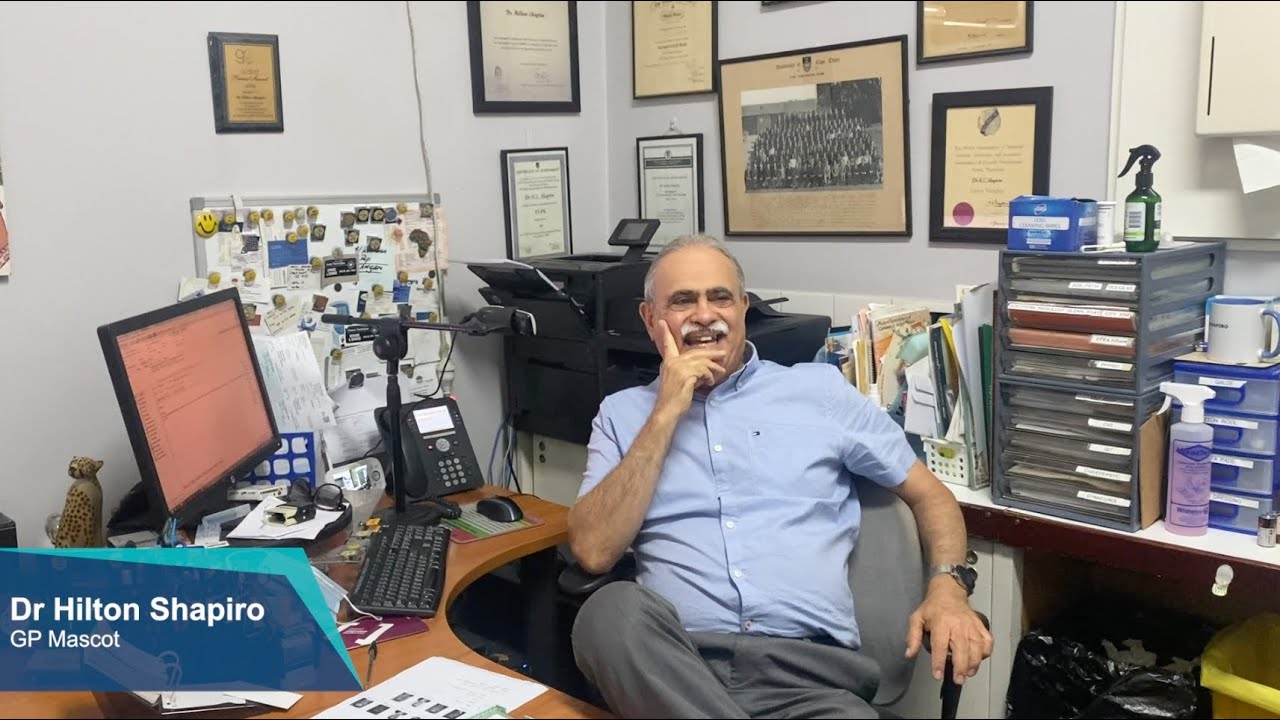
Dr Hilton Shapiro, from Mascot, has been made aware of what LAHC has done — and he feels very strongly about it. He has referred this matter to Diabetes Australia / the Diabetes Council.
The medical dimension is not incidental. The tenant is diabetic and depends on his weekly payments to fund his diabetic medication — the same payments Housing NSW seized in full. A government agency that leaves a diabetic in a mould-ridden, powerless home and then strips his weekly income is a health matter, and a doctor has now put it in front of the body that exists to advocate for exactly these patients.
Dr Hilton Shapiro · Mascot, NSW
THE QUESTION THE DOCUMENTS LEAVE ON THE TABLE.
Strip away every contested claim and one fact remains, sealed and signed: a NSW government agency told a tribunal it would fix this by November. It is now winter again. The work is not done, the power has failed, and the rent has gone up nearly seven-fold. The only open question is who, if anyone, will be held responsible — and whether "we're inspecting" is still an acceptable answer from a government to a court.
Every factual claim sourced to a tribunal order in this article is verifiable from the sealed documents below. Click any file to open it in the evidence viewer, or download directly.
NCAT Orders & Applications — Case 2025/00005577 · 2026/00090755
7 sealed tribunal documents · Full originals
▼
PDF
NCAT consent order, 1 August 2025 (Case 2025/00005577)
Keystone document · Consent order + 15 Apr 2026 order · Mould remediation · Rent cap $77.95/wk · $291.80 compensation
Open →
PDF
Fresh NCAT application, 4 March 2026 (Case 2026/00090755)
Tenant returns to tribunal — consent-ordered repairs never completed
Open →
PDF
NCAT order, 29 April 2026 — Virtual attendance
Tenant granted leave to appear virtually
Open →
PDF
NCAT order, 1 May 2026 — "The landlord is inspecting"
Adjourned because respondent landlord is inspecting — 6 months after deadline
Open →
PDF
NCAT order, 18 June 2026 — Adjourned by consent
Another adjournment — by consent
Open →
PDF
Request for urgent/expedited hearing, 26 June 2026
Emergency application — power failure + $520 rent + Ausgrid note + mould photos as annexures
Open →
IMG
Ausgrid note to housing electrician (Ref. 66693)
Faulty main switchboard · Life-support customers · Replace directive · Never actioned
Open →
Photographic Evidence — Mould at the Premises
3 photographs · Wall and ceiling surfaces · Present despite Nov 2025 remediation order
▼
IMG
Mould at the premises (1 of 3)
Wall and ceiling mould — photographed post-remediation-deadline
Open →
IMG
Mould at the premises (2 of 3)
Wall and ceiling mould — painted over, bled back through
Open →
IMG
Mould at the premises (3 of 3)
Wall and ceiling mould
Open →
New Character — Adnan AlijaAlija Concrete · The Slur · The Judgment
"I'M NOT PAYING YOU BECAUSE YOU'RE A FAGGOT."
Adnan Alija is the founder of Alija Concrete. What follows separates two things carefully: the allegations, which are described as allegations, and the court record, which speaks for itself.
It is alleged that while his girlfriend — who was brought to Australia from overseas — was pregnant, Adnan Alija entered into a sexual relationship with Adam Watson and a friend of Adam's, both of whom are Muslim. That is an allegation, and it is presented as one.
What sits alongside it is harder to reconcile. Alija Concrete engaged Adam Watson for work and never paid. The alleged stated reason for not paying was as blunt as it was ugly: "I'm not paying you because you're a faggot." A private relationship on one hand; a homophobic slur weaponised to avoid a debt on the other. The contradiction is the story.
On the Record — The Judgment
Adam Watson took the unpaid debt to court and obtained a judgment against Adnan Alija. That is not an allegation — it is a matter of record.
The judgment has since done what judgments do. Adnan Alija was recently knocked back for a bank loan because of it — a recorded judgment debt is exactly the kind of thing a lender declines on. With the loan blocked, he reached out to Adam, now asking to pay the debt — in exchange for a Notice of Discontinuance.
It is worth sitting with that reversal. The man who allegedly refused to pay because of who Adam is now needs Adam's signature to move on with his own finances. The slur was free when there was nothing at stake. The moment the judgment stood between him and a bank, the position changed.
PDF
Form 33 — Notice of Discontinuance · Watson v Alija Concrete
Court document · The instrument Adnan Alija has requested in exchange for paying the judgment debt
New Incident — Southport OfficeworksTwo Charges · A $20 Item · $10 Held
TWO CHARGES OVER A $20 PAIR OF HEADPHONES.
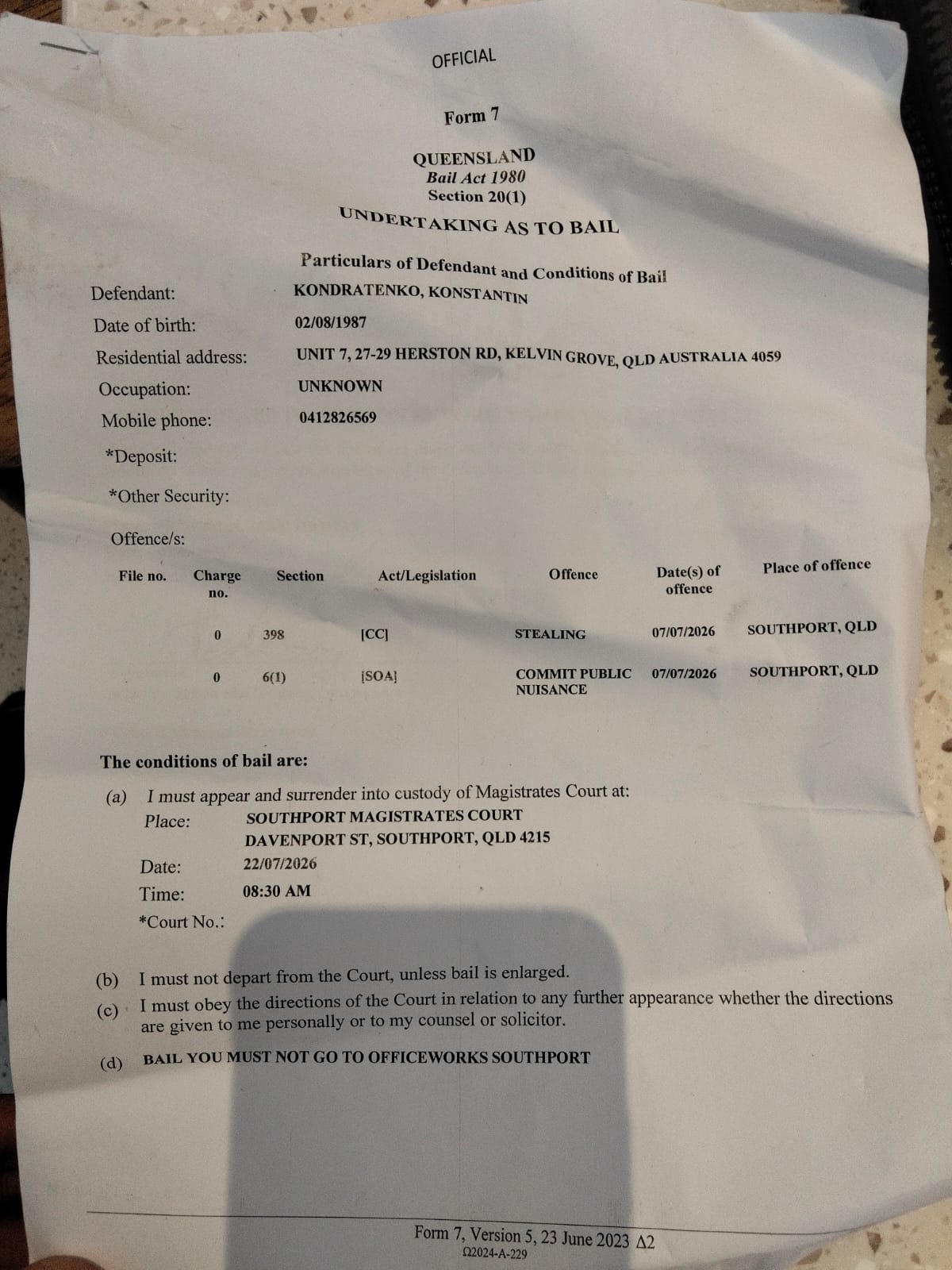
Queensland Police brought two charges against Kosta Kondratenko over an incident at Officeworks Southport. This is his account of what happened, and why. The matter is listed for mention — it has not been to trial, and nothing here is a finding of any court. Should police elect to proceed to a full trial, the outcome will be reported at the end.
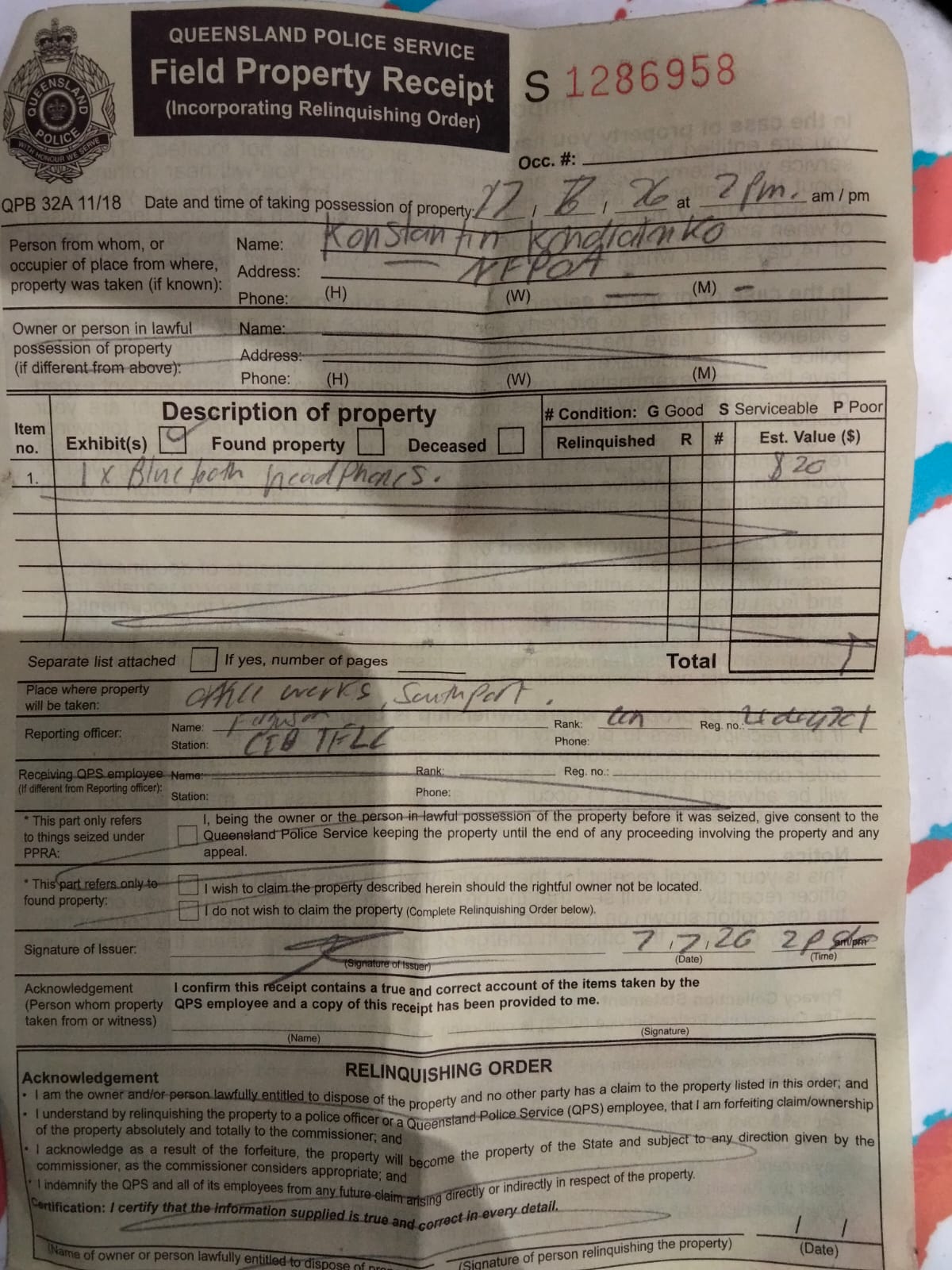
Queensland Police · Two charges laid Item seized · Field Property Receipt issued
Undertaking to Bail · Two charges
Field Property Receipt · The item seized — a $20 pair of headphones
What Actually Happened
It started at the self-service machines. Adam Watson was trying to print, and the machine wouldn't scan. Adam complained to Kosta about the scanning issue. Kosta went into Officeworks and told a staff member what had happened. The response was "Well, that's all right" — and Kosta explained that, no, it is not all right.
Kosta asked to speak to the person who had aggravated Adam. The manager would not allow it — he said only that he would handle it himself, and refused to let Kosta speak to the person who had caused the problem in the first place.
At that point, on Kosta's account, all he did was point a finger. He walked out. Then he came back in and took a pair of headphones. The logic was one the staff had themselves supplied: the machine had taken Adam's money and not given it back, and a worker had said Adam would get that money back in 14 days. So Kosta said he would take the $20 headphones for 14 days — and when the money came back, they could have their headphones back. If the machine can hold a customer's money for 14 days, the reasoning went, the customer can hold a $20 item for the same 14 days.
The staff called the police. Kosta was arrested within 10 minutes. The officer did not appear to have the full story. Kosta explained the issue — the held money, the 14-day promise, the refusal to let him speak to anyone — and the officer proceeded with the arrest without any attempt to resolve the underlying issue whatsoever.
Why It Happened — The $10 Officeworks Kept
Adam Watson
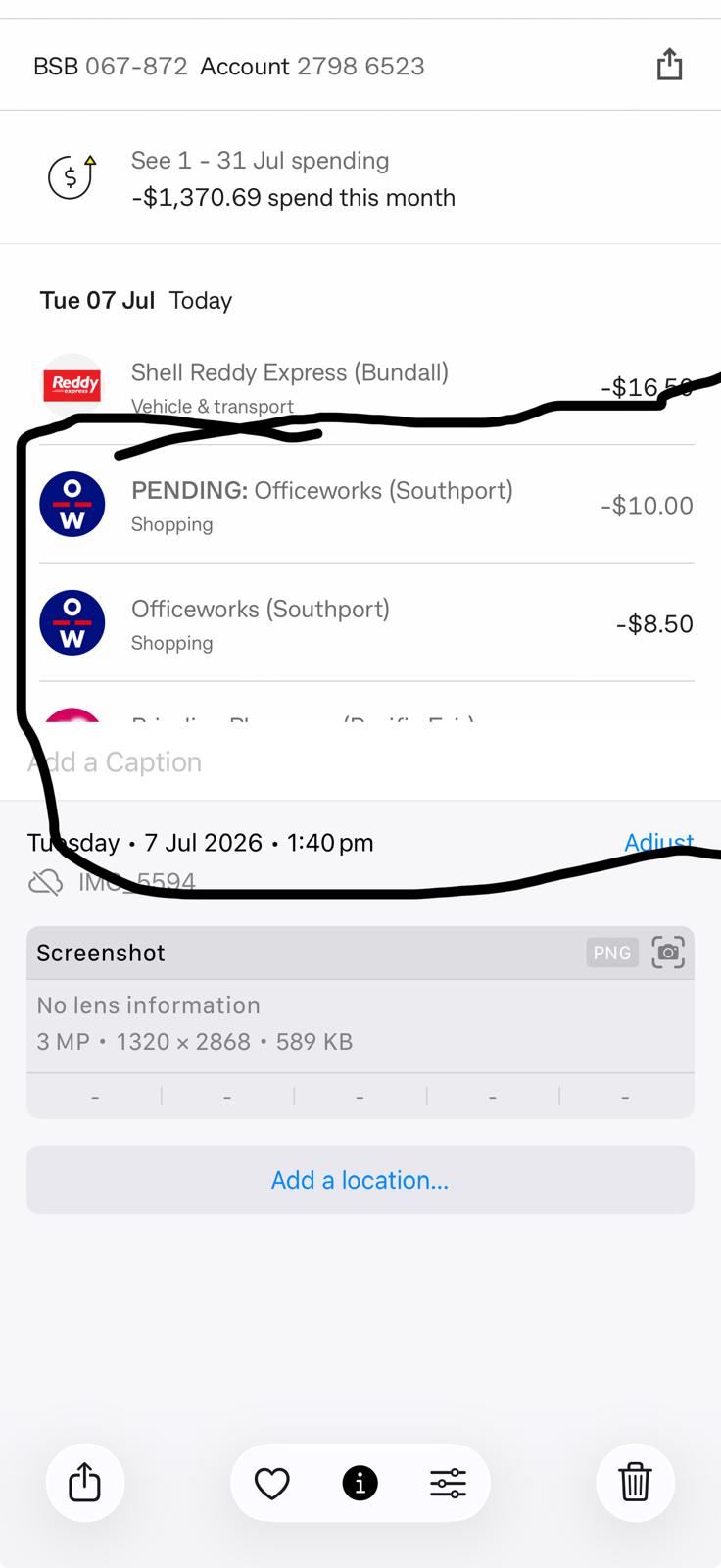
This did not happen over nothing. Officeworks took $10 from Adam Watson for his printing and did not return it. The receipt showing Officeworks holding that money is below. The headphones were never about $20 worth of headphones — they were a stand-in for money the store had taken and would not give back.
There is also a piece of property that has never been accounted for. Since the police removed the item from Kosta's bag, his charger has gone missing — and its value is considerably higher than the $20 headphones that generated the charges. The Field Property Receipt above records what was taken; the charger is not coming back.
Proof · Officeworks holding Adam Watson's $10
The Culture at Southport Officeworks
The incident does not sit in isolation. It goes to the culture of the staff at Officeworks Southport, who — on Adam Watson's repeated experience — never help him with the self-service printers. Adam has also complained that the printing is set to colour by default. He believes this is a deliberate attempt to extract money from customers — charging colour rates even when the pages are plainly black and white.
It is not only customers who describe it that way. An Officeworks staff member at Robina has said she never rosters herself onto shifts at the Southport store because of the culture and the people there — and that, in her view, the staff seem trained to be unhelpful.
Escalated — The Owner of Officeworks
Rob Scott · CEO, Wesfarmers
Officeworks is owned by Wesfarmers. Its CEO, Rob Scott, has been contacted about the culture of the staff at the Southport store. He has indicated he will look at the complaint numbers for that location to determine whether this is a valid, recurring concern rather than a one-off.
That is the right response to a complaint of this kind: check whether the data backs it up. If the volume of complaints against Officeworks Southport is elevated, it tells its own story — and it would corroborate exactly what a Robina staff member has already said out loud about that store.
The Bigger Issue — Procedure and Held Money
Strip the personalities out of it and two questions remain. The first is about police procedure. When someone is standing in a store openly explaining that they have taken a $20 item because the store is holding their associate's money, the proportionate response is to offer to let them simply pay for the item, or, at the very least, to listen to the underlying issue before reaching for handcuffs. Neither happened. The officer proceeded to arrest without attempting to resolve anything.
The second is bigger, and it is the real question this case raises: what right does a store like Officeworks have to take a customer's money and hold it — for 14 days or at all — without giving it back? A self-service machine that takes payment and fails to deliver the service has not completed a sale; it has taken money. The clean fix is obvious: charge only the amount the customer agrees to pay before printing — the exact page count, in the correct colour mode — so the machine never holds money it has no service to justify. Get that right and incidents like this one do not begin.
Sunlight.Quest
Accountability journalism · NSW / Queensland
Encrypted · Source protected · Triangulated for verification
Subject of tip-off required
Do not include names of uninvolved third parties unless essential to the account.
Evidence / material optional
You retain file ownership — we access read-only.
Physical handoff optional
Triangulation context
Your details optional
RECEIVED.
Your intelligence report has been logged. If you provided contact details, expect a response within 48 hours.